Guide
French drain installation
Installing a French drain is a digging job with one design decision inside it: where the water leaves. Fix the outlet and the slope first, and the rest is fabric, stone and pipe placed in a set order.
Short answer: French drain installation follows a fixed order: choose a lower outlet, call 811, dig a trench about 14 inches wide and 22 inches deep that falls at least 1 percent, line it with non-woven fabric, bed 4 inches of washed stone, lay 4-inch perforated pipe holes down, cover it with stone, wrap the fabric and finish the surface.
On this page
This page is the build sequence. It covers how to install a French drain in a yard or along a slope, the tools and materials for a typical run, how to check the fall before anything is buried, and the point where a DIY French drain stops being sensible. For what the system is and where each type belongs, start at the French drains hub.
The dimensions below come from the U.S. Department of Energy's Building America Solution Center guide to swales, drains and site grading, the most detailed public specification for a residential yard drain. Local practice varies by an inch or two in each direction. The order of work does not.
Plan the route and the outlet first
Start at the end. Before working out how to build a French drain, find the place the water will leave, because that point sets the depth, the length and the cost of everything upstream of it.
- Find the outlet. Daylight on a downslope is the first choice. Where the lot has no lower ground, the water goes to a dry well or a sump instead. The page on French drains, dry wells and catch basins compares the three.
- Check the fall. At 1 percent, a 50-foot drain needs 6 inches of drop and a 100-foot drain needs 12 inches, on top of the depth at the start. If the ground does not give it to you, the trench has to get deeper as it runs. The depth and slope guide works through the numbers.
- Draw the line. Run the shortest route from the wet area to the outlet that keeps falling the whole way. To stop water arriving from uphill, run the trench across the slope above the wet ground rather than through the middle of it.
- Keep clear of trouble. Stay off a septic drain field, out of the root zone of mature trees, and away from any route that would discharge onto a neighbor's lot. NRCS Conservation Practice Standard 606 names willow, cottonwood, elm and soft maple as the trees most likely to send roots into a drain.
Then confirm the drain is the right tool. If the wet spot sits below a downspout, a $40 extension or a rain garden handles the roof water at the source and may remove the need for a trench at all.
Tools and materials
Nothing on the list is specialized. The quantities below are for a 50-foot yard drain in a trench 14 inches wide and 22 inches deep.
| Material | What to buy | How much |
|---|---|---|
| Pipe | 4-inch rigid perforated PVC, plus solid pipe of the same size for the outlet end | 50 ft perforated, at least 10 ft solid |
| Stone | Clean washed stone, 3/4 inch, no fines | About 2 to 2.5 cubic yards |
| Fabric | Non-woven geotextile filter fabric | 50 ft long, at least 5 ft wide |
| Fittings | Couplings, an end cap or cleanout riser for the high end, a guard for the outlet | As the route requires |
| Surface | Topsoil and sod, or more washed stone to grade | To fill the top 9 inches |
Stone is the item people under-order. Use the French drain gravel calculator to convert your trench dimensions into cubic yards and tons, and read the pipe, gravel and fabric guide before buying anything in bags. Materials for a yard drain come to $6 to $16 per foot, so $300 to $800 for this run.
Tools: marking paint, stakes and mason's string, a line level or laser level, a tape measure, a trenching shovel, a mattock for roots and stones, a wheelbarrow, tarps for the spoil, a utility knife for the fabric, a saw for the pipe and a garden rake.
Machine or hand. A rented walk-behind trencher saves the most labor, but typical rental units cut a slot only 4 to 6 inches wide and 24 to 36 inches deep. That is narrower than a gravel drain wants, so a trencher run gets widened by hand. A mini excavator with a narrow bucket digs the full width in one pass where there is room to get it in.
How to install a French drain, step by step
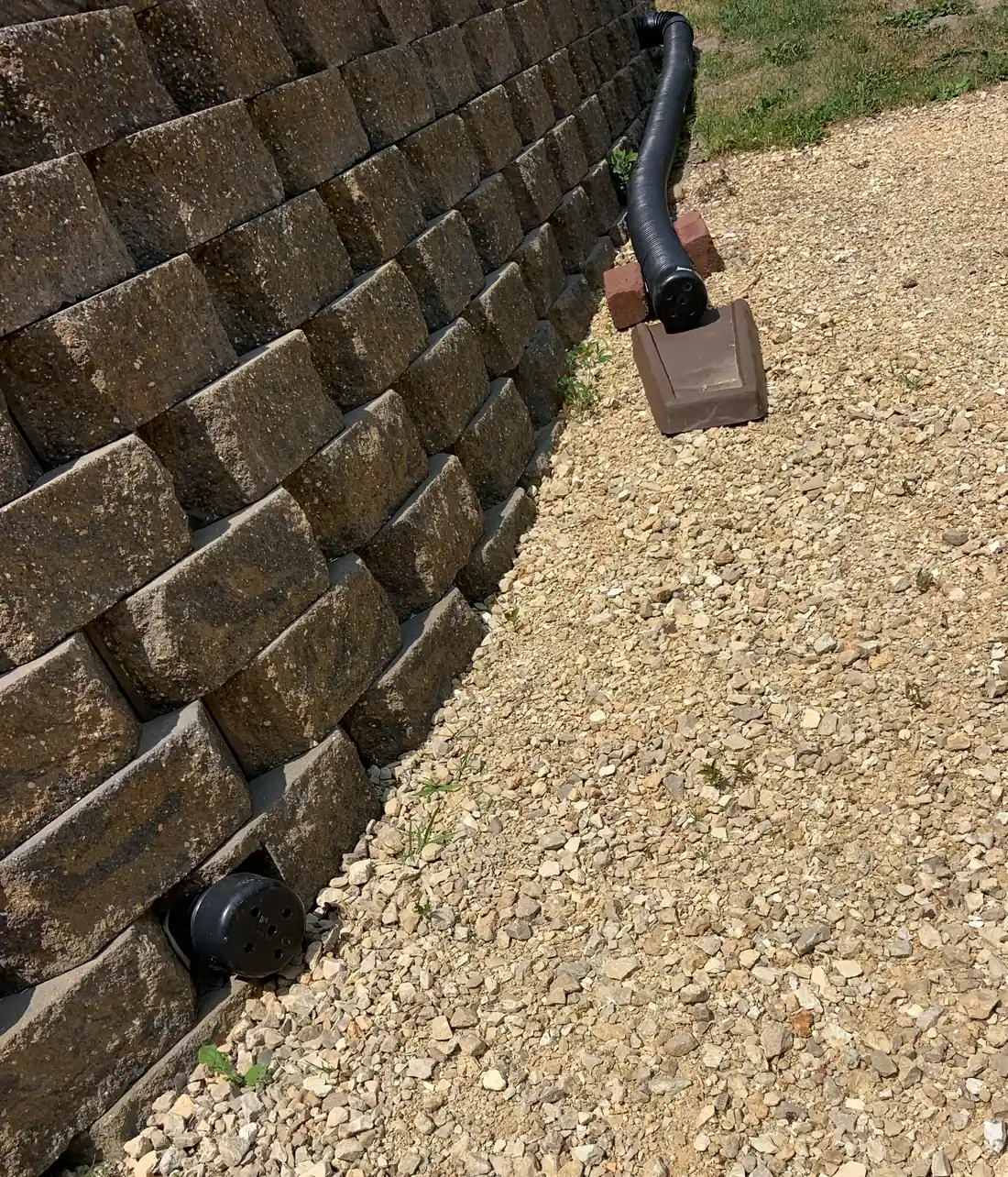
The cross-section shows what the finished trench looks like. Every step below builds one layer of it, from the bottom up.
- Plan the route and the outlet. Walk the line from the wet area to the discharge point and confirm the outlet is lower than the trench bottom will be at the start. If it is not, stop and redesign. Nothing built after this step can fix a drain with nowhere to go.
- Call 811. The service is free, and it asks for contact a few business days before digging so each utility can mark its lines. Wait until every utility has responded. Marks are color coded: red is electric, yellow is gas. 811 does not mark private lines, so find irrigation pipe, lighting cable, propane and septic lines yourself.
- Lay out the trench. Stake both ends, pull a string between them and paint the line on the ground. Paint a second line for the spoil pile at least 2 feet back from the trench edge, and spread tarps there so the soil comes back off the lawn cleanly.
- Dig the trench. Cut the sod and set it aside if you plan to reuse it. Dig at least 14 inches wide and 22 inches deep, hand digging near any utility marks. States set a tolerance zone around each mark, commonly 18 to 24 inches either side, where only careful hand work is allowed. Shape the bottom so it falls steadily toward the outlet with no humps or hollows.
- Line it with fabric. Unroll non-woven geotextile along the trench, pressing it into the bottom corners. It must be wide enough to run across the bottom, up both sides and past the edges, because the surplus gets folded over the stone later. Overlap the ends where two rolls meet.
- Place the bedding gravel. Spread about 4 inches of clean washed stone on the fabric and rake it to the fall. This layer, not the soil below it, is the final grade the pipe rests on, so take the time to get it even.
- Lay the pipe, holes down. Set 4-inch perforated pipe on the bedding with the perforations facing down and join the lengths with couplings. Cap the high end, or fit a riser to the surface there so the line can be flushed later.
- Check the slope. Before any more stone goes in, measure the fall along the pipe as described in the next section. Then run a hose into the high end and watch the outlet end. Fixing a dip now takes a rake. Fixing it later takes a shovel and a weekend.
- Backfill with stone. Place washed stone beside the pipe and then over it until there are 4 to 6 inches above the top of the pipe. Shovel it in along both sides evenly so the pipe is not pushed off line.
- Wrap the fabric. Fold the two sides of the fabric over the top of the stone, lapping one side over the other, so the gravel is enclosed on all sides. Any gap left here is where soil gets in.
- Cover the trench. Fill the top 9 inches or more. Use topsoil and sod if the drain is intercepting water moving below the surface. Carry washed stone to grade instead if water has to enter from the surface. Mound soil slightly, because the fill settles.
- Build the outlet. Change from perforated to solid pipe for the final stretch and bring it out onto ground that slopes away from the house. Set stones or a splash block under the opening to stop erosion, and fit a guard to keep animals out.
(Sources: Building America Solution Center, "Swales, Drains, and Site Grading for Stormwater Control", for trench size, bedding depth, perforations down, stone cover, fabric lap and surface cover; NRCS Conservation Practice Standard 606 for the outlet; the national 811 service and state 811 centers for locate rules.)
Checking the slope before you bury it
A French drain needs a minimum fall of 1 percent: 1 foot per 100 feet of run, or about 1 inch every 8 feet. That is the same 1/8 inch per foot that the International Residential Code, section P3005.3, sets for gravity drain piping 3 inches and larger.
The simplest way to measure it is with a level string. Drive a stake at each end of the trench, tie a string between them and level it with a line level or a laser. The string is now a flat reference above the trench. Measure down from the string to the top of the pipe every 10 feet. Each reading should be about 1 1/4 inches larger than the one before it.
- If two readings in a row are the same, that stretch is flat. Lift the pipe and rake out bedding on the downhill side.
- If a reading gets smaller, the pipe is running uphill there, and water will stand behind the hump.
- Over 50 feet, the last reading should be at least 6 inches greater than the first.
More fall is fine. Less is the failure that cannot be seen once the trench is closed, which is why the check comes before the stone.
How long the job takes
The calendar starts with the locate request, a few business days before any digging. After that, the time is almost entirely earth and stone.
A 50-foot trench at 14 by 22 inches holds about 4 cubic yards of soil. All of it comes out, and roughly 2 to 2.5 cubic yards of stone goes back in, with the leftover soil hauled away or spread elsewhere. Laying fabric and pipe is the quick part. Hand digging in clay or roots takes far longer than the same trench cut by machine.
Order the stone for delivery beside the trench, not at the curb. Moving 2 cubic yards by wheelbarrow across a yard is a job of its own.
Common mistakes when installing a French drain
Most failures are set up during the build and discovered years later. These are the ones made with the trench still open.
- Digging before the marks are down. A yard drain works at the depth where service lines are buried.
- Grading the soil but not the bedding. The pipe follows the stone it sits on. A lumpy bedding layer undoes a well-cut trench.
- Fabric cut too narrow. If it cannot lap over the top, soil washes into the stone from above.
- Unwashed stone. Stone delivered with dust and fines brings the clog with it.
- Perforated pipe all the way to the outlet. The last stretch should be solid, rigid pipe. NRCS Standard 606 calls for a continuous section without perforations at the outlet end, at least 10 feet long for pipe 8 inches and smaller, and says single-wall corrugated pipe is not suitable there.
- An unprotected outlet. With no guard and no stone under it, the outlet becomes a burrow or a gully.
- Planting over the line. The Building America guide advises against shrubs or trees over or near the drain pipe.
- Sending the water next door. The outlet has to discharge on your own lot, onto ground that carries it away without flooding a neighbor.
The repair and maintenance guide covers what to do when one of these shows up in a drain that is already buried.
DIY French drain or contractor
A shallow yard French drain with a daylight outlet is a reasonable project for a homeowner who is willing to dig. Delaware's Department of Natural Resources and Environmental Control describes simple yard drains 8 to 24 inches deep as do-it-yourself work, and puts deeper drains and drains close to a foundation in contractor territory.
Hire the job out when any of these apply:
- The trench goes deep. Federal construction rules (OSHA, 29 CFR 1926.652) require cave-in protection for workers in trenches 5 feet or deeper. An exterior foundation drain at footing level is far past that line.
- The trench runs beside the house. Digging next to a footing can undermine the wall the drain is meant to protect.
- The work is inside. An interior basement French drain means cutting the slab and installing a sump.
- There is no gravity outlet. A dry well or pump adds design decisions and, for a pump, electrical work.
- The route crosses hardscape. Cutting and replacing a patio, walkway or driveway is its own trade.
The price gap is mostly labor and machine time. A contractor-installed yard drain runs $18 to $40 per linear foot against $6 to $16 per foot in materials for the same trench built yourself. The French drain cost page has a calculator for both, and you can request quotes there to check a bid against the estimate.
Pricing a real project? Run the numbers in the French drain cost calculator, then request quotes from local drainage contractors to check them against the market.
After the first storm
Go and look at the outlet during the first real rain. Water should be running from it while the ground upstream is wet, and the flow should taper off as the ground drains. No flow with standing water still in the yard means the drain is too shallow for the water it was meant to catch, or the stone is not connected to the wet area.
Expect the trench line to settle over the first season. Top it up with soil or stone rather than leaving a furrow that collects silt. Then keep the outlet clear: Delaware's guidance for yard French drains is to clear debris, leaf litter and nests monthly and to confirm once a year that the drain is working.
If the trench was dug to keep water off a basement wall and the wall is still damp after a wet month, the problem is deeper than a yard drain reaches. The guide to foundation and basement water covers how to tell which kind of water you have, and the French drain diagrams show how the footing-level versions differ from the one built here.
Common questions
Can I install a French drain myself?
A shallow yard drain is a realistic DIY job. Delaware's environmental agency describes simple yard French drains 8 to 24 inches deep as do-it-yourself projects and says deeper drains, or drains close to a foundation, need a drainage contractor. Materials run $6 to $16 per foot. Footing-depth work is not a homeowner job: trenches 5 feet or deeper need cave-in protection.
Do the holes in a French drain pipe go up or down?
Down. The U.S. Department of Energy's Building America Solution Center specifies perforated pipe laid with the perforations down, on a bed of clean stone. Water rises into the trench from the bottom, so holes at the bottom let the pipe start carrying water at the lowest level, and they keep the top of the pipe closed to anything settling from above.
How much slope does a French drain need?
At least 1 percent, which is 1 foot of fall per 100 feet of run, or about 1 inch every 8 feet. A 50-foot drain needs its outlet end at least 6 inches lower than its start. The trench bottom must fall continuously, because any dip holds water and collects silt.
What do you put in the bottom of a French drain trench?
Fabric first, then stone, then pipe. Line the trench with non-woven geotextile, spread about 4 inches of clean washed stone, and set the perforated pipe on that bed with the holes down. The pipe never sits directly on soil, and the fabric always sits between the soil and the stone.
Do I need to call 811 before digging a French drain?
Yes. 811 is the free national before-you-dig service, and it asks for contact a few business days before any digging so utilities can mark their buried lines. It does not mark private lines such as irrigation, low-voltage lighting, propane or septic pipes, so locate those separately before trenching.
How long does it take to install a French drain?
Plan on the utility locate first, which takes a few business days, then the dig. A 50-foot trench 14 inches wide and 22 inches deep means moving about 4 cubic yards of soil out and more than 2 cubic yards of stone in, so most of the time goes to digging and hauling rather than to laying pipe.