Calculator
Rainwater collection calculator
Enter the roof footprint and the rainfall. The calculator returns gallons collected per storm and per year, and the number of barrels needed to hold a storm.
Rainwater collection calculator
| Quantity | Amount |
|---|
One inch of rain on one square foot is 0.623 gallons. The result is that figure times roof area, rainfall and the efficiency you entered.
How to use the rainwater collection calculator
Enter the roof footprint that drains to the tank: the length times the width of the building under that section of roof, not the sloped surface. Rain falls vertically, so pitch does not change the catch. Enter one storm's rainfall to size storage and a year's rainfall to see the annual total. The efficiency setting accounts for water that never reaches the tank.
How much rainwater can I collect: the formula
Gallons equal roof footprint in square feet, times rainfall in inches, times 0.623, times collection efficiency.
The 0.623 is exact arithmetic: a square foot is 144 square inches, one inch of rain on it is 144 cubic inches, and a gallon is 231 cubic inches. The Texas Water Development Board, whose rainwater harvesting manual is a widely used public reference, rounds it to 0.62 and generally applies an efficiency of 0.85.
Worked example
A 1,000 square foot roof in a 1 inch storm: 1,000 times 1 times 0.623 is 623 gallons falling on the roof, and 530 gallons collected at 85 percent. Over a year with 32 inches of rain, the same roof yields about 16,950 gallons. Holding the whole 1 inch storm takes ten 55 gallon barrels.
Gallons by roof size
| Roof footprint | Per inch of rain | At 20 in per year | At 40 in per year |
|---|---|---|---|
| 500 sq ft | 265 | 5,296 | 10,591 |
| 1,000 sq ft | 530 | 10,591 | 21,182 |
| 1,500 sq ft | 794 | 15,886 | 31,773 |
| 2,000 sq ft | 1,059 | 21,182 | 42,364 |
| 2,500 sq ft | 1,324 | 26,478 | 52,955 |
| 3,000 sq ft | 1,589 | 31,773 | 63,546 |
Sizing the storage
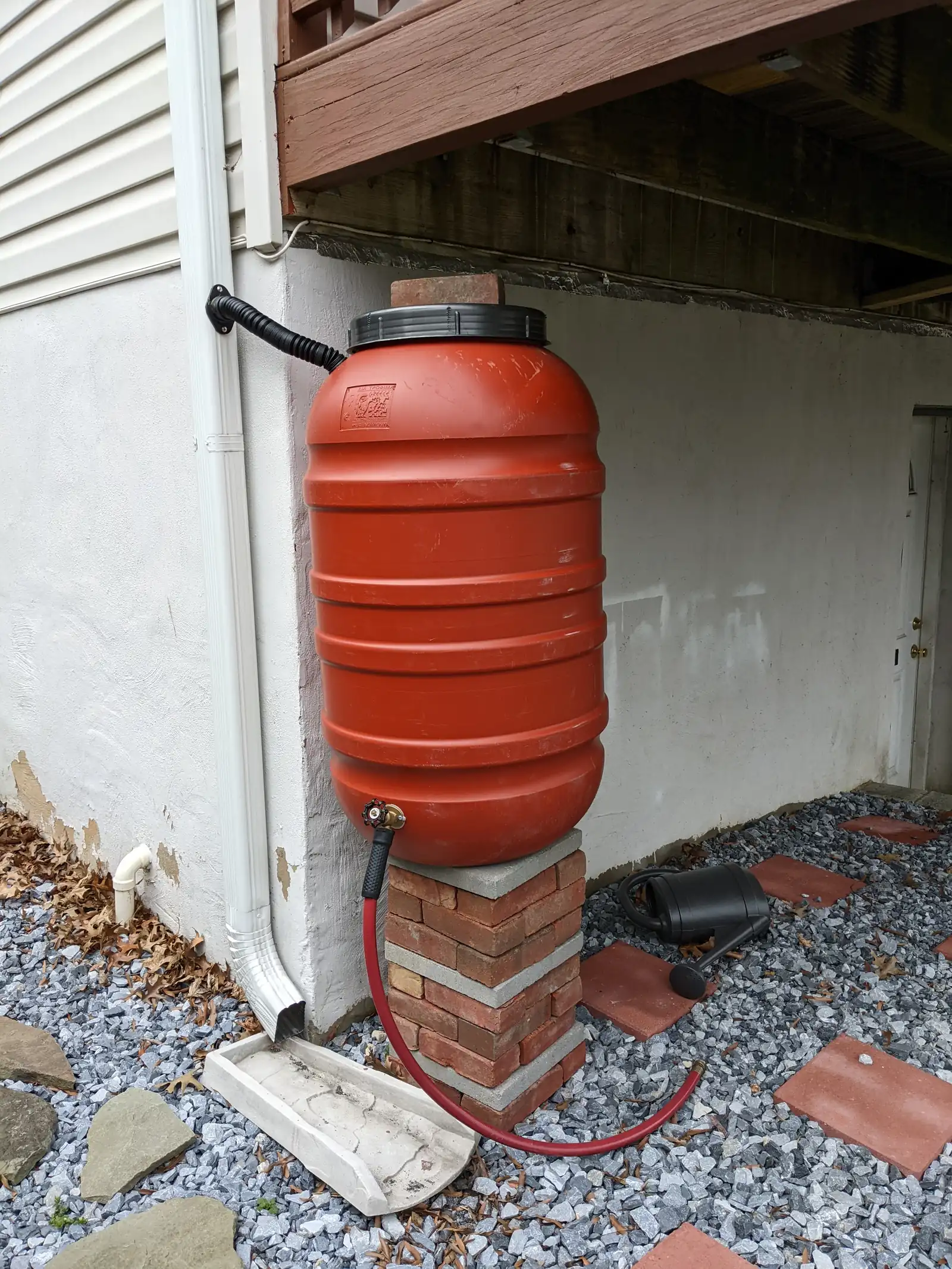
This rainwater harvesting calculator shows why a single rain barrel fills so fast. A 55 gallon rain barrel is full after about a tenth of an inch of rain on a 1,000 square foot roof. That is fine for watering containers, but it does almost nothing for runoff, because every storm after the first tenth of an inch overflows.
Storage sized for use depends on how quickly you draw the water down between storms. Storage sized for runoff control has to be empty before the next storm arrives, which usually means a slow-release outlet. In both cases the overflow needs somewhere safe to go, away from the foundation.
Where the overflow goes
A tank overflow dumping beside the house recreates the problem a downspout causes. Route it to a rain garden, which is sized to soak in exactly this kind of flow, or to a dry well: the guide to French drains, dry wells and catch basins explains the difference. If water already reaches the basement, read foundation and basement water first.
The rain garden sizing calculator on raingardens.spawnusa.org starts from the same roof area and tells you how big a garden absorbs the runoff. For the wider picture, the yard drainage solutions page matches each water problem to a fix, and Get involved lists what a single household can do for its watershed. If the overflow will run through a stone-lined swale, the river rock calculator sizes the stone. All tools are on the calculators page.
Common questions
How much rainwater can I collect from my roof?
One inch of rain on one square foot of roof footprint yields 0.623 gallons. A 1,000 square foot roof sheds 623 gallons per inch of rain, of which about 530 gallons can be collected at a typical 85 percent efficiency.
How many gallons is 1 inch of rain on a 2,000 square foot roof?
About 1,246 gallons fall on the roof. At 85 percent collection efficiency, roughly 1,060 gallons reach the tank.
How many rain barrels do I need?
Divide the gallons from a storm by the barrel size. A 1,000 square foot roof in a 1 inch storm yields about 530 gallons, which fills ten 55 gallon barrels. Most homes capture only part of a storm and let the rest overflow to a safe outlet.
What is collection efficiency?
The share of the rain that actually reaches storage after splash, gutter overflow, evaporation and first-flush diversion. The Texas Water Development Board's rainwater harvesting guidance generally uses 0.85, and some of its material uses about 0.80.