Comparison
French drain vs dry well vs catch basin
These are not three versions of the same thing. One collects water from the ground, one collects it from the surface, and one gets rid of it. Most working yard systems use two of the three.
Short answer: French drain vs dry well vs catch basin comes down to the job. A French drain collects groundwater along a line. A catch basin collects surface water at a point. A dry well disposes of water by letting it soak into the ground. They are usually combined: collectors feeding one outlet.
On this page
Every drainage system has two halves: something that collects water and somewhere for it to go. Most disappointing installations got one half right. This page sorts the three most common components into those halves and shows how they connect. For the trench itself, start with the French drain guide.
Three components, three jobs
French drain: collects from the soil, along a line. A fabric-lined trench of washed stone with a perforated pipe at the bottom. Water in saturated ground moves into the open stone, drops to the pipe and runs downhill. It works slowly and continuously over its whole length. It handles water in the ground well and sudden surface flow poorly.
Catch basin: collects from the surface, at a point. A box set in the ground with a grate on top and a pipe leaving its side. Water running across the surface drops through the grate and leaves through solid pipe. It handles a puddle or a concentrated flow in minutes. It does nothing for water already in the soil.
Dry well: disposes into the ground. A buried pit filled with stone, or a perforated chamber, that receives piped water, stores it and lets it soak into the surrounding soil. It collects nothing by itself. It is an outlet, used where there is no downhill place to send water.
Side-by-side comparison
| Factor | French drain | Catch basin | Dry well |
|---|---|---|---|
| Job | Collect | Collect | Dispose |
| Water it handles | Groundwater and seepage in the soil | Surface runoff and puddles | Whatever is piped to it |
| Shape | A line | A point | A buried reservoir |
| Pipe | Perforated | Solid | Solid inlet, perforated or open inside |
| Needs an outlet | Yes | Yes | It is the outlet; needs an overflow |
| Depends on soil | Works in most soils if it has an outlet | No | Entirely; fails in soil that does not drain |
| Main failure | Silt in the gravel; no outlet | Sump full of debris; grate blocked | Soil clogs or never drained; stays full |
| Maintenance | Check outlet, flush pipe | Clean the sump | Keep sediment out; check it empties |
| Typical cost | $18 to $40 per linear foot installed in a yard | Priced with the pipe run it serves | $1,500 to $4,000 |
When to use a French drain
- The ground is soft and saturated over an area, not just puddled at one spot.
- Water is seeping out of a slope. A curtain drain across the hillside intercepts it; see French drains in a yard.
- Groundwater is rising at a footing. That is an exterior French drain around the foundation or an interior basement French drain.
- There is a lower point to drain to, or the budget includes a dry well or pump.
A French drain is the wrong tool for roof water and for sheet flow across a patio. Those arrive too fast, and they carry grit that silts the stone.
When to use a catch basin drain
A catch basin drain is the fix for water you can see moving or standing: the bowl in the lawn, the bottom of a driveway, the spot where two roof valleys empty.
- Put it at the true low point. Water has to run to the grate without help. Set the grate slightly below the surrounding surface.
- Choose a basin with a sump. In stormwater practice a catch basin has a sump below the outlet pipe that traps trash, debris and coarse sediment before they enter the pipe (Source: Connecticut Stormwater Quality Manual, deep sump catch basins). On a yard basin, that sump is what protects everything downstream.
- Clean it. The same manual sets the cleaning target at no more than half full. A sump packed with leaves passes debris straight into the pipe.
- Pipe it in solid pipe, with fall. The line from a basin only carries water. It needs the same continuous slope as any drain; the depth and slope guide has the figures.
A catch basin still needs somewhere to send the water. On a flat lot that is often a dry well, which is where soil limits come in.
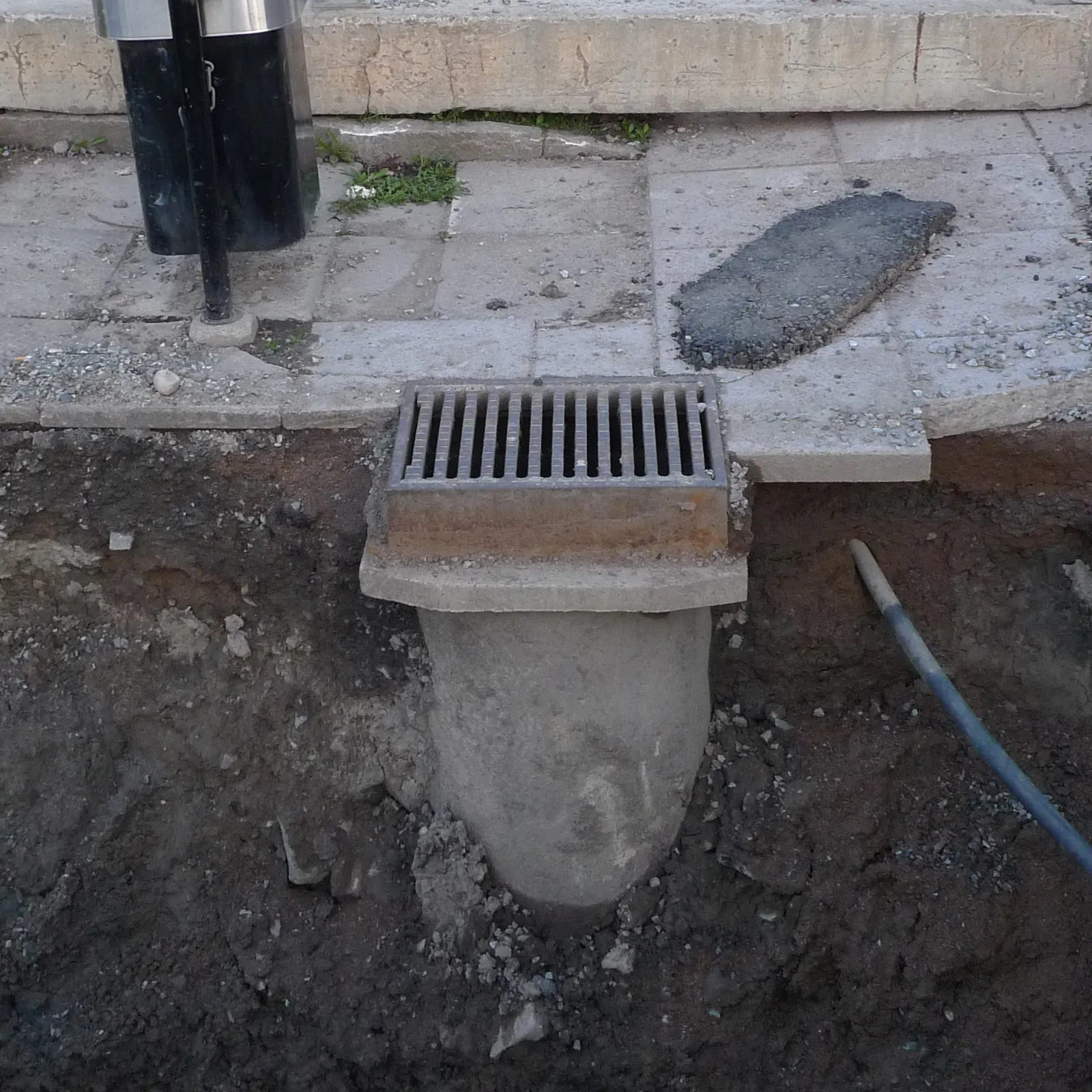
Dry wells and their soil limits
A dry well is storage plus soakage. Water fills the voids between the stones, or the open space inside a chamber, and leaves through the bottom and sides into the surrounding soil. It can only empty as fast as the soil accepts water. That one fact decides whether a dry well works on a given lot.
The reference used here is the Pennsylvania Stormwater Best Management Practices Manual, BMP 6.4.6, one of the more detailed public standards for residential dry wells. Its limits:
- Drain-down time. The maximum is 72 hours. Longer drain-down reduces capacity for the next storm and can lead to anaerobic conditions and odor.
- Distance from the house. In general, 10 feet of separation between a dry well and a building foundation. Dry wells are not recommended where they would create a significant risk of basement seepage or flooding.
- Overflow. Every dry well should be able to send overflow to a downstream drainage path when a storm exceeds its capacity.
- Clean water only. Dry wells are intended for roofs and other surfaces with low sediment loading. Sediment seals the soil at the bottom of the pit, and that cannot be undone without digging it up.
- Frost. The design depth should take frost depth into account.
(Source: Pennsylvania Stormwater Best Management Practices Manual, BMP 6.4.6, Dry Well / Seepage Pit.)
In practice this rules dry wells out on heavy clay, where the water table is high, and close to basements. Test before committing: dig a hole to the planned depth of the dry well, fill it with water, let it drain, fill it again and time the second fill. If the hole is still holding water days later, a dry well in that spot will too. Local codes can add their own setbacks from property lines, wells and septic systems.
A dry well moves the problem underground. If the soil does not accept the water, the pit fills, the pipe feeding it backs up, and the yard floods exactly as before with $1,500 to $4,000 buried in it. Soil first, then design.
Dry well installation
Dry well installation follows the same logic as a French drain: clean stone, fabric to keep soil out, and no compaction of the soil that has to absorb the water. The sequence below follows the Pennsylvania manual's construction steps.
- Locate it. Downhill of what it serves, 10 feet or more from foundations, clear of utilities. Call 811 first.
- Excavate to a level bottom. Keep machinery out of the pit and do not compact the subgrade. The soil at the bottom is the working surface.
- Line the pit. Wrap it completely in non-woven geotextile, with generous overlaps, so soil cannot migrate into the stone.
- Set the pipe and an observation well. The inlet pipe enters near the top. A capped vertical pipe to the surface lets you see the water level and pump the pit out if it ever stops draining.
- Fill with stone. Clean, washed, uniformly graded aggregate, placed in layers. The manual describes typical dry wells as 18 to 48 inches of stone. A prefabricated chamber can replace most of the stone and stores far more water in the same hole.
- Close the top. Fold the fabric over the stone and cover with at least 12 inches of soil, then seed.
- Protect the inlet. A screen or filter on the downspout or a sump in the catch basin upstream keeps leaves and grit out.
- Provide the overflow. A surcharge pipe or pop-up outlet set so that excess water surfaces away from the house.
Sizing principles
Sizing a dry well is volume arithmetic, and it is where most undersized ones are born.
Water in. An ordinary 1,500 square foot roof sheds roughly 900 gallons in a single inch of rain. A cubic foot holds about 7.5 gallons, so that is about 120 cubic feet of water. The rainwater collection calculator runs the figure for any roof area and rainfall.
Storage. In a stone-filled pit only the voids hold water. The Pennsylvania manual's formula is dry well area times water depth times 40% for stone fill. Working backward, 120 cubic feet of water needs about 300 cubic feet of stone: a pit 10 feet by 10 feet with 3 feet of stone. That is roughly 11 cubic yards, a far bigger hole than most people picture, and the reason chambers are popular.
Water out. Storage only helps if the pit empties before the next storm. The soil test above tells you whether it will.
For stone quantities, the French drain gravel calculator converts a length, width and depth into cubic yards and tons, and works for a pit as well as a trench. Catch basins and the pipes between components are sized to local rainfall intensity, which varies too much across the country to reduce to one number here; a local drainage contractor or the municipal stormwater office will have the design storm for your area.
How they combine into one system
Think of collectors and outlets. Any collector can feed any outlet, and several collectors can share one.
- French drain to daylight. The simplest system: the perforated run turns into solid pipe and surfaces on a downslope. Use it wherever the lot has fall.
- French drain to dry well. For a soggy, flat lot with soil that drains below the wet layer.
- Catch basin to dry well. For a surface low spot on a flat lot. The basin's sump keeps sediment out of the well.
- French drain, catch basin and shared outlet. The common full system. A French drain catch basin combination puts the basin at the low spot for surface water and runs the perforated trench through the ground that stays soft. The basin's solid pipe and the French drain meet downstream of the perforated section and share one outlet.
Two connection rules prevent most failures. First, surface water travels in solid pipe. Routing a catch basin or a downspout into the perforated section pushes water out into the soil being drained and carries sediment into the stone. Second, the outlet sits lowest. Every collector must fall to it, and a dry well must be deep enough that its inlet is below the pipes arriving.
The French drain diagrams page shows these layouts in plan view, and French drain repair and maintenance covers keeping each part clear.
When a rain garden replaces all three
A dry well soaks water in below ground where nobody can see it working or failing. A rain garden does the same job at the surface: a shallow planted basin that takes roof or driveway runoff and infiltrates it, typically within 24 to 48 hours. It needs the same draining soil a dry well does. In exchange it is cheaper to build, easy to inspect, and simple to repair because the soaking surface is on top.
For roof water on a lot with room and suitable soil, a rain garden is usually the better disposal point. The rain garden guide covers siting and sizing. Where the water is in the ground and not coming off a roof, it is back to a French drain.
Cost
A contractor-installed yard French drain runs $18 to $40 per linear foot, and a curtain drain $25 to $55. A dry well adds $1,500 to $4,000. Daylight is free, which is why it is always the first outlet to look for. A catch basin is priced as part of the pipe run it sits on.
The French drain cost calculator lets you price a run with a daylight, dry well or sump outlet and see what the outlet does to the total. For the wider picture of where water on a lot should go, see the overview of yard drainage solutions.
Common questions
Is a dry well better than a French drain?
They do different jobs, so one does not replace the other. A French drain collects water along a trench and moves it somewhere else. A dry well receives water and lets it soak into the ground. A dry well is the better choice only for disposal, on a lot with no downhill outlet and soil that drains.
Can a French drain drain into a dry well?
Yes. A dry well is a standard outlet for a French drain on a flat lot. The dry well has to sit lower than the drain, in soil that lets it empty between storms, and it needs an overflow for the storm that fills it. In clay or where the water table is high, the dry well stays full and the drain backs up.
What is the difference between a French drain and a catch basin?
A French drain is a gravel trench with a perforated pipe that takes in water slowly from the soil along its whole length. A catch basin is a box with a grate that takes in surface water quickly at one point and sends it down a solid pipe. Soggy ground calls for a French drain. A puddle calls for a catch basin.
How far should a dry well be from a house?
Pennsylvania's stormwater manual recommends 10 feet of separation between a dry well and a building foundation, and advises against dry wells wherever they would create a risk of basement seepage. Local codes may set a different distance, and may add setbacks from property lines, wells and septic systems, so check with the building department.
Do dry wells work in clay soil?
Poorly. A dry well only empties as fast as the surrounding soil accepts water, and dense clay accepts it very slowly. Stormwater guidance sets a maximum drain-down time of 72 hours. A dry well that cannot meet it stays full, which means it has no capacity for the next storm. In clay, drain to daylight or pump instead.