Materials guide
French drain pipe, gravel and fabric
A French drain is three materials doing three jobs. The stone collects the water, the pipe carries it and the fabric keeps the soil out of both. Most drains that fail early were built with the wrong version of one of them.
Short answer: The standard French drain pipe is 4-inch rigid perforated PVC, laid holes down in clean washed 3/4-inch angular stone, with non-woven geotextile lining the trench and folded over the top. Corrugated pipe, pea gravel, woven fabric and pipeless systems all have uses, but each gives up capacity or service life.
On this page
- Three materials, three jobs
- French drain pipe: rigid PVC or corrugated
- Perforations: holes down
- Pipe diameter
- Sock or no sock
- French drain gravel: washed angular stone, pea gravel or river rock
- Why fines clog a drain
- French drain fabric: non-woven, not woven
- Pipeless French drain systems and their limits
- How much to buy
This guide covers what to buy and why. For the order the materials go into the trench, see the French drain installation steps. For how the system works as a whole, see the French drains hub.
Three materials, three jobs
Water moves through soil toward the easiest path. A trench of open stone is that path, so the stone does the collecting. The pipe at the bottom is a fast lane that carries the collected water to the outlet. The fabric is a filter between the soil and the stone that lets water through and holds soil particles back.
Each material fails in its own way. Stone fails when its gaps fill with silt. Pipe fails when it sags, crushes or fills with sediment. Fabric fails when it is missing, torn, or fine enough to seal. Buying well means choosing the version of each that resists its own failure for longest.
The materials are also the small part of the bill. Pipe, stone and fabric for a yard drain come to $6 to $16 per foot, and the rest of a contractor's price is labor and machine time. The French drain cost guide breaks that down.
French drain pipe: rigid PVC or corrugated
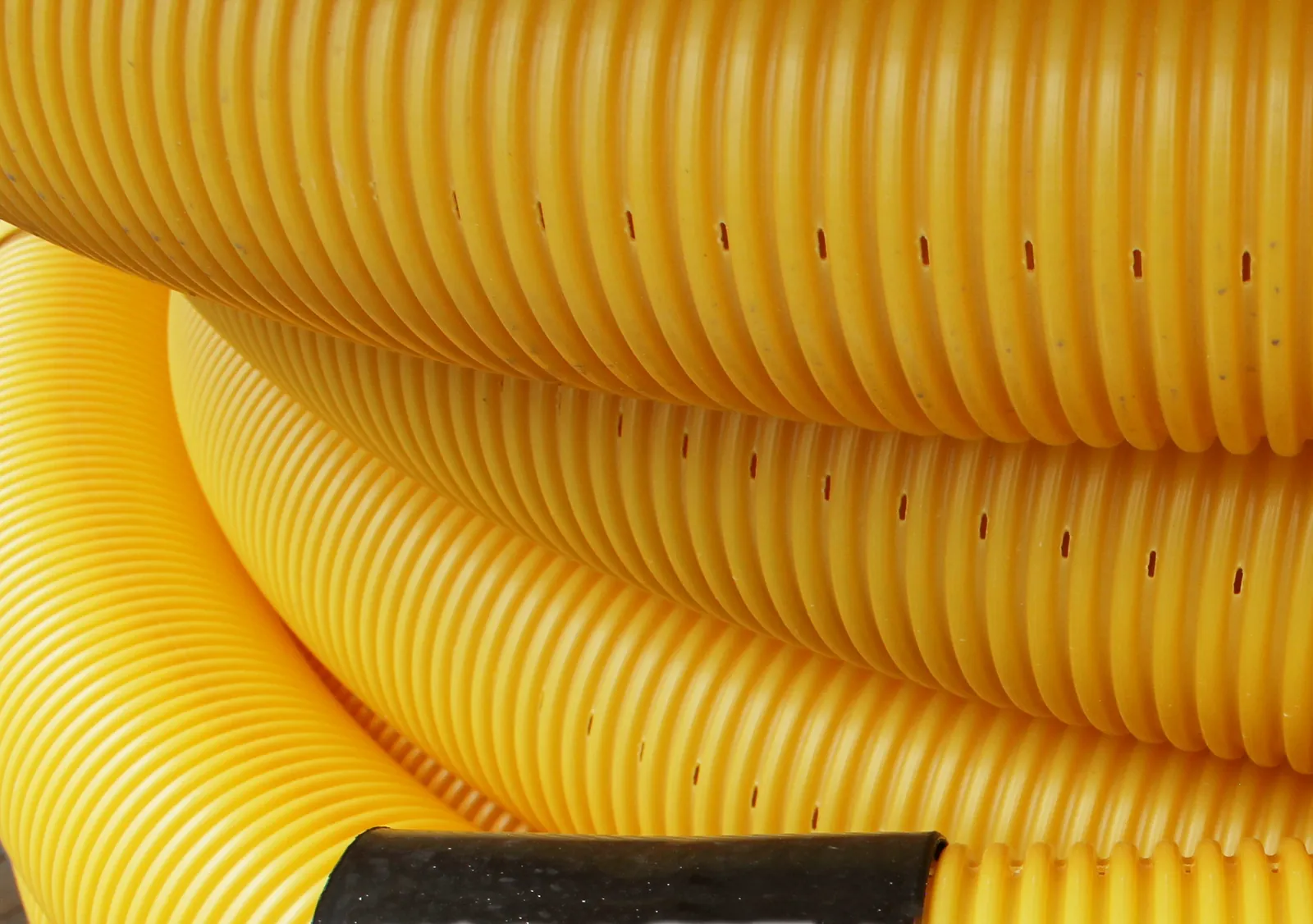
The perforated pipe for French drain work is sold in two forms. Rigid PVC drain pipe comes in straight lengths with two rows of holes along one side. Corrugated polyethylene pipe comes in flexible coils with slots cut between the ridges.
| Property | Rigid perforated PVC | Corrugated polyethylene |
|---|---|---|
| Standard it is made to | ASTM D2729 | AASHTO M 252 |
| Inside wall | Smooth | Ridged in single-wall pipe |
| Holds a slope | Yes, it spans small hollows in the bedding | Follows every dip in the bedding |
| Sediment | Flushes through | Ridges catch it |
| Cleaning | Takes a hose or a drain snake | Hard to snake without snagging |
| Curves | Needs fittings | Bends by hand |
| At the outlet | Suitable as the solid outlet section | Single-wall pipe is not suitable (NRCS Standard 606) |
| Best use | Long runs, shallow slopes, anything hard to dig up again | Short, curved yard runs with plenty of fall |
The public guidance leans one way. The U.S. Department of Energy's Building America Solution Center says smooth PVC pipe is preferable to corrugated pipe, which is more likely to collect sediment and clog. Corrugated pipe is not wrong. It costs less, it goes in fast, and on a short run with a steep fall its drawbacks rarely matter. On a long run at the minimum slope they matter a great deal, because a pipe that sags an inch at 1 percent has a section running level.
Whatever carries the water through the trench, the final stretch to the outlet should be solid rigid pipe. NRCS Conservation Practice Standard 606 calls for a continuous section of rigid pipe without perforations at the outlet end, at least 10 feet long for pipe 8 inches and smaller.
Perforations: holes down
Rigid perforated PVC made to ASTM D2729 has two rows of 1/2-inch holes. They go at the bottom. The Building America Solution Center specifies the pipe laid with perforations down in both its yard drain and footing drain guides.
The reason is the direction water arrives from. A trench fills from the bottom up, like a bathtub. With the holes at the bottom, the pipe starts taking water as soon as the level reaches it. With the holes on top, the water has to rise the full height of the pipe before any of it leaves, so the stone beside the pipe stays saturated. Holes on top also leave the pipe open to anything that settles down through the stone.
Use perforated pipe only where the drain is collecting. Where the line is just carrying water, across a dry part of the yard or out to the discharge point, switch to solid pipe so the water is not released again along the way.
Pipe diameter
Four inches is the residential standard. It is the size in the federal Building America guidance for both yard and footing drains and in Louisiana State University AgCenter's homeowner publication on French drains. NRCS Standard 606 sets 3 inches as the minimum nominal diameter for any subsurface drain, and the Northern Virginia Soil and Water Conservation District puts the usual range at 4 to 6 inches.
The trench has to fit the pipe plus stone on every side. The Building America footing drain guide sizes the trench for a 4-inch pipe at 16 inches wide and deep, which leaves 6 inches of clearance around it. A larger pipe needs a wider trench and more stone, which the depth and slope guide covers. Where one line cannot reach all the wet ground, a second line collects from more of it than a larger pipe would.
Sock or no sock
A sock is a sleeve of filter fabric fitted over the pipe at the factory. It keeps sand and silt out of the perforations. It does nothing for the stone around the pipe.
That is the whole decision. In a trench lined with fabric and filled with washed stone, the fabric at the trench wall is already the filter, and the stone inside it stays clean. A sock there is a second filter with nothing left to catch. Where the pipe is laid in sand or directly in soil with little or no stone, the sock is the only filter there is, and it earns its place.
Two conditions argue against relying on fabric close to the pipe. NRCS Standard 606 warns that where the silt content of the soil exceeds 40 percent, a geotextile filter has to be chosen so it will not clog during its design life, and that iron ochre, a bacterial deposit found in some soils, can seal fabric filters. A filter out at the trench wall has about four times the surface area of a sock on a 4-inch pipe, so the same silt is spread much thinner.
French drain gravel: washed angular stone, pea gravel or river rock
The stone is the working part of the drain. Stormwater design manuals assign clean stone a porosity of about 0.4 (Maine Department of Environmental Protection, Stormwater Best Management Practices Manual), meaning roughly 40 percent of a trench filled with it is open space for water to sit in and move through.
| Stone | What it is | Around the pipe | Notes |
|---|---|---|---|
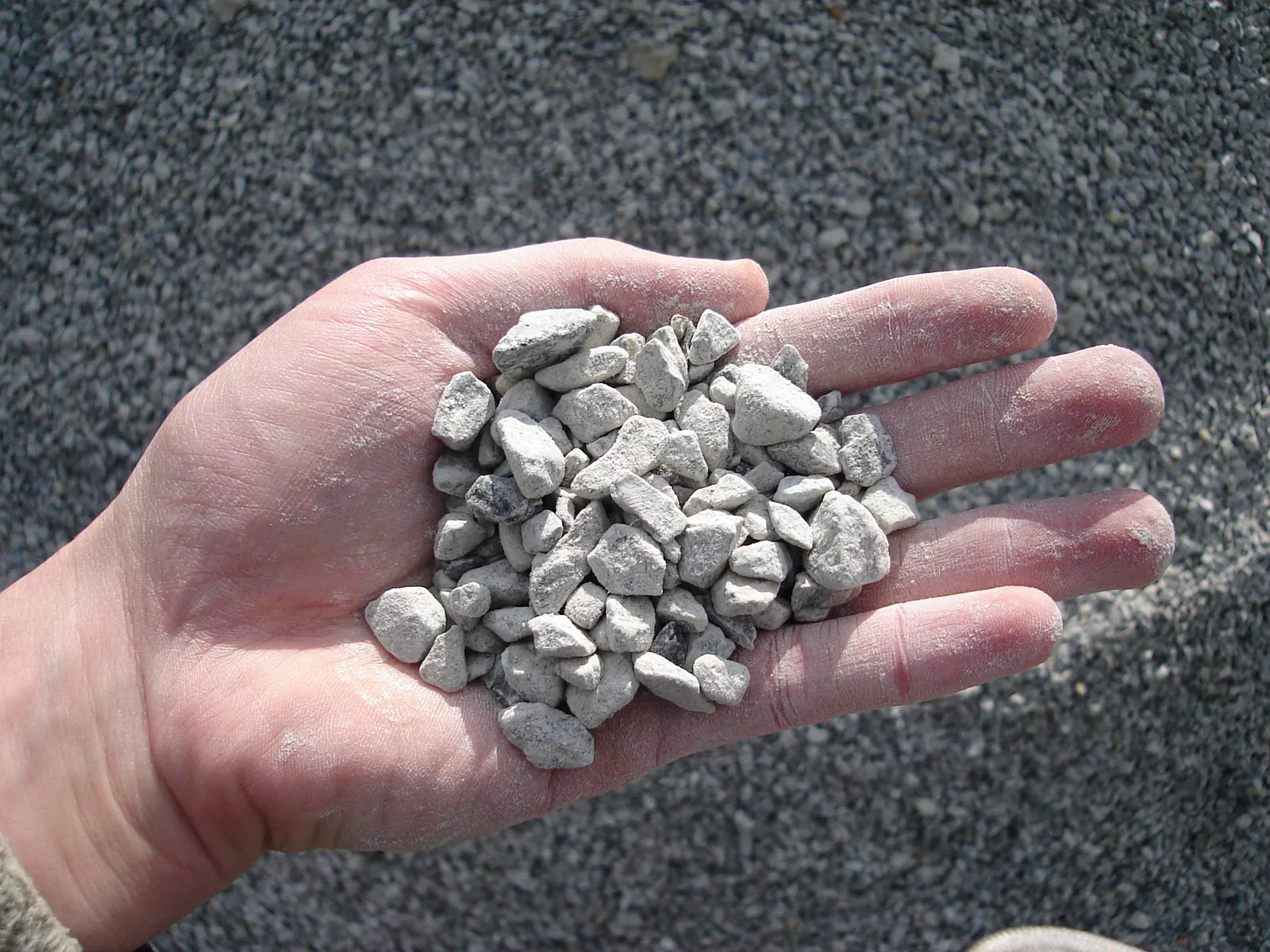
| Washed angular stone, 3/4 inch (No. 57) | Crushed rock, screened and washed | Yes, the default | Angular pieces lock together and stay put under the pipe |
| Washed river rock | Rounded stone, usually larger | Acceptable if washed and 3/4 inch or larger | Does not lock together, and is mostly sold as a decorative stone |
| Pea gravel | Rounded stone, about 3/8 inch and smaller | No | Smaller than the 1/2-inch holes in rigid drain pipe |
| Crusher run, road base, unwashed gravel | Crushed rock with its dust and fines left in | No | Made to pack tight, which is the opposite of what a drain needs |
Washed angular stone. No. 57 is the aggregate size commonly sold as 3/4-inch clean stone. Under the ASTM C33 and AASHTO M 43 gradation, all of it passes a 1 1/2-inch sieve, 95 to 100 percent passes a 1-inch sieve and no more than 10 percent passes a No. 4 sieve, so there is almost nothing in it small enough to migrate. The Building America footing drain guide calls for washed gravel of 1/2 to 3/4 inch, free of silt and sand. Its yard drain guide accepts clean rock from 3/4 inch to 2 inches.
Pea gravel. The International Residential Code, section R405.1, requires the stone under and over a foundation drain pipe to be at least one sieve size larger than the perforation. Pea gravel fails that test against 1/2-inch holes. It can enter the pipe, and the gaps between its stones are smaller. It is a good surface for the top of a trench. If that is the plan, size it with the pea gravel calculator.
River rock. Clean, rounded river rock drains well and is often used as the visible top layer of a drain that takes surface water. The river rock calculator gives quantities for a decorative cap. The same angular-versus-rounded logic applies at a larger scale to shoreline armor, where riprap has to be angular so the stones lock together on a slope.
Why fines clog a drain
Fines are the dust, silt and sand-sized particles in a load of stone or in the soil around the trench. A drain works because of the gaps between stones. Fines are small enough to wash into those gaps and too large to wash out of them, so they collect, and each particle that lodges makes the gap smaller for the next one.
They arrive by three routes. They come in with the stone if it was not washed. They wash in from the trench walls and from above if the fabric is missing or does not close over the top. And they enter through the pipe perforations if the stone around the pipe is smaller than the holes. A clogged trench looks the same from the surface as a working one, which is why the hub lists dirty gravel among the main ways French drains fail and why the fault is usually found years later.
Standards for drain envelopes limit fines directly. NRCS Standard 606 allows no more than 5 percent of the envelope material to pass a No. 200 sieve. For a homeowner, the practical version is to buy stone described as washed or clean, look at it before it is tipped, and reject a load that leaves a cloud of dust or a muddy film on wet hands.
French drain fabric: non-woven, not woven
The right French drain fabric is a non-woven geotextile, the felt-like kind made of matted fibers. The references agree on it. NRCS Standard 606 names nonwoven geotextile where it calls for wrapping drain joints. Penn State's Center for Dirt and Gravel Road Studies recommends lightweight non-woven geotextile for stone underdrains. The Building America yard drain guide calls for 8-ounce landscape filter fabric.
Woven geotextile, the kind that looks like a plastic tarp or a feed sack, is made for strength and for separating layers under driveways and stone swales. None of the drainage references checked for this page call for it inside a drain trench. Plastic sheeting and thin weed-barrier film are not filter fabric at all.
Placement matters as much as type:
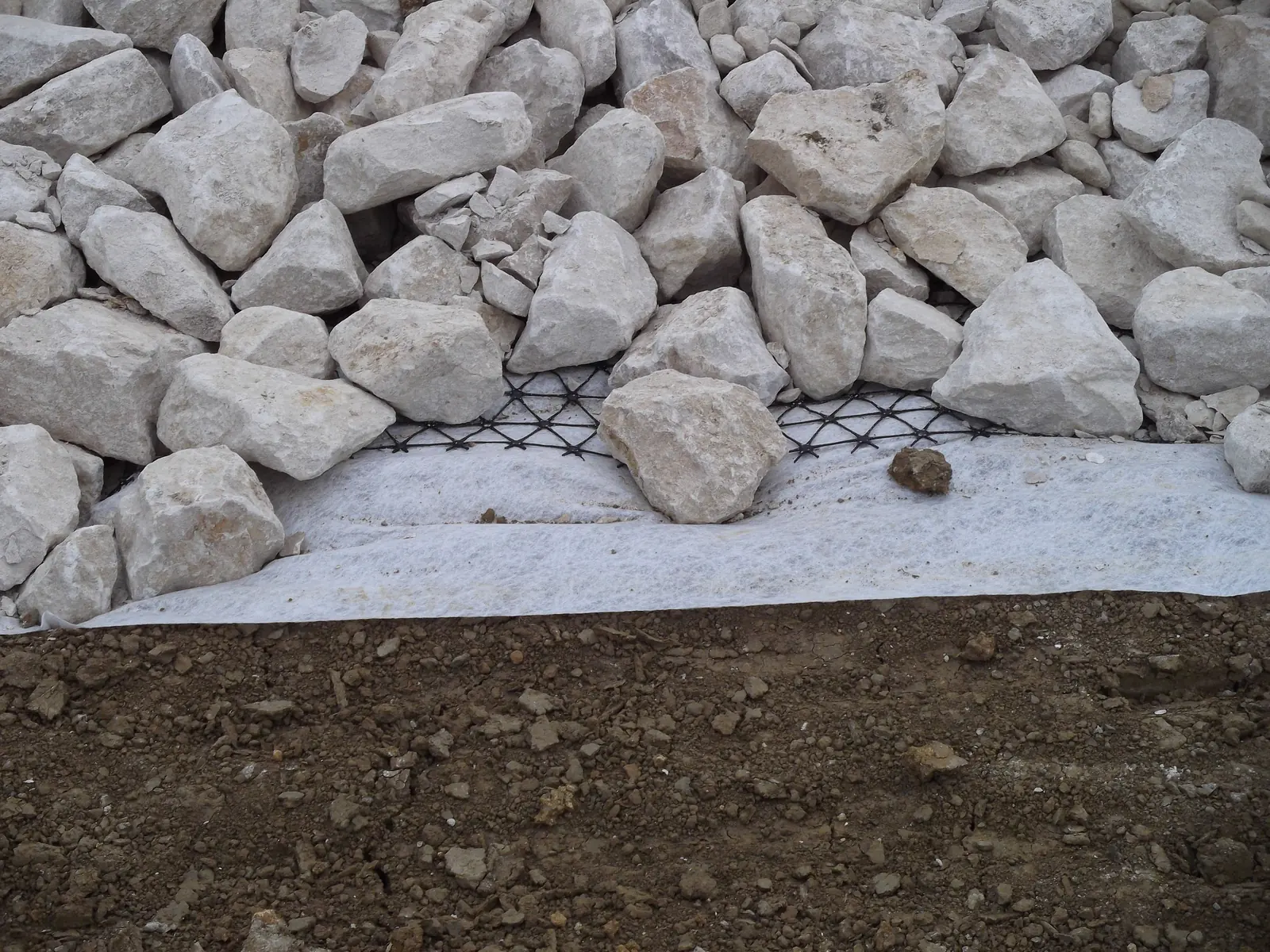
- Line the trench, not just the pipe. Fabric goes against the soil on the bottom and both sides, with the stone inside it.
- Close the top. Fold the sides over the stone and lap one over the other. Penn State's bulletin calls for enough material to form a double layer on top of the drain.
- Buy enough width. A trench 14 inches wide holding 13 inches of stone needs 14 inches for the bottom, 13 for each side and 14 or more to lap over the top: at least 5 feet.
- Leave the top open only on purpose. Where stone runs to the surface to take in surface water, the fabric need not cover the top, but its edges have to be protected from sediment (Northern Virginia Soil and Water Conservation District).
The code position is short. Section R405.1 of the International Residential Code requires gravel foundation drains to be covered with an approved filter membrane, and perforated drains to be surrounded by one or by stone that is.
Pipeless French drain systems and their limits
A pipeless French drain is one of two different things, and they should not be confused.
Gravel only
The original French drain had no pipe. It is a trench of clean stone wrapped in fabric, and it still works: water moves through the gaps in the stone along the slope of the trench. Penn State's Center for Dirt and Gravel Road Studies describes exactly this as a constructed stone underdrain and notes that capacity can be increased by embedding a perforated pipe in the stone.
The limits follow from that. Water moves far more slowly through stone than through an open pipe, so a gravel-only trench carries less. It also cannot be flushed or snaked. When it silts up, the repair is to dig it out. It suits short runs, light flows and plenty of fall.
Prefabricated, aggregate-free sections
The second kind is not really pipeless. It is a factory-made bundle: a slotted corrugated pipe surrounded by lightweight plastic aggregate, usually expanded polystyrene, held in a mesh or fabric sleeve. The sections drop into a narrow trench and are backfilled with soil, with no stone to haul. The Northern Virginia Soil and Water Conservation District notes that pre-assembled kits can save installation time and effort.
The limits are different:
- Fixed size. A bundle is the size it is. Penn State lists the advantages of a constructed stone drain over a prefabricated one as the ability to size it for any flow and shape it to the site, and better, longer performance in clay soils because of its larger surface area.
- The sleeve is the only filter. The same cautions about silty soil apply, with less surface area to spare.
- Loading. Check the manufacturer's rating before running a section under a driveway or anywhere vehicles cross.
- Corrugated core. The pipe inside has the same sediment and cleaning limits as any corrugated pipe.
Prefabricated sections make sense where hauling stone is the obstacle, such as a back yard with no machine access. For a drain protecting a building, such as an exterior foundation drain or an interior basement system, pipe in washed stone remains the standard, and the foundation drainage section of the building code is written around it.
How much to buy
Quantities come straight from the trench dimensions.
- Stone. Width times stone depth times length. A 14-inch trench with 13 inches of stone holds about 1.26 cubic feet per foot of run, so a 50-foot drain needs about 63 cubic feet, or 2.3 cubic yards. The French drain gravel calculator does the conversion to cubic yards and tons. For other shapes and stone types, the general rock calculator works from any length, width and depth.
- Pipe. Perforated pipe for the collecting length, plus solid pipe for the run to the outlet, plus couplings, a cap or cleanout for the high end and a guard for the outlet.
- Fabric. The trench length plus overlap at each joint, at the width worked out above.
Round the stone order up, not down. Trenches are never dug as neatly as they are drawn, and running short means a second delivery for a small amount.
The French drain diagrams show where each material sits in the finished trench, and the repair and maintenance guide covers cleaning and repairs for older drains built with the wrong ones.
Common questions
What kind of pipe is best for a French drain?
Rigid perforated PVC, 4 inches in diameter, is the better choice for most runs. The U.S. Department of Energy's Building America Solution Center says smooth PVC is preferable to corrugated pipe, which is more likely to collect sediment and clog. Corrugated pipe is cheaper and bends around obstacles, which suits short, curved yard runs.
What is the best gravel for a French drain?
Clean, washed, angular stone of about 3/4 inch with no fines, often sold as No. 57 stone. Federal building guidance for footing drains calls for washed gravel of 1/2 to 3/4 inch, free of silt and sand. Avoid crusher run and any unwashed stone, because the fine material fills the gaps that water is supposed to move through.
Can I use pea gravel for a French drain?
It is a poor choice around the pipe. Pea gravel is sold at about 3/8 inch and smaller, which is smaller than the 1/2-inch holes in standard perforated PVC drain pipe, and the residential building code wants drain stone at least one sieve size larger than the perforation. Use washed 3/4-inch stone in the trench and keep pea gravel for the surface.
Does a French drain need landscape fabric?
Yes, in almost every soil. Non-woven geotextile lining the trench and folded over the top of the stone keeps soil fines out of the gravel. The residential building code requires an approved filter membrane over gravel foundation drains, and drainage references from NRCS and Penn State specify non-woven fabric for the job.
Does a French drain need a pipe?
Not always. A trench of clean stone wrapped in fabric drains on its own and is the original form of the French drain. Penn State's Center for Dirt and Gravel Road Studies notes that embedding a perforated pipe in the stone increases capacity. A pipeless drain suits short runs and light flows, and it cannot be flushed if it silts up.
Should French drain pipe have a sock?
Only where the pipe is the sole filter, such as corrugated pipe laid in sand. In a trench lined with fabric and filled with washed stone, the fabric already does the filtering at the soil boundary, and a sock adds a second layer that fine silt or iron deposits can seal.