Guide
Riprap: what it is, rock sizes and how it is built
Riprap is a blanket of heavy, angular stone that armors a bank against waves and current. This guide covers the rock, the size classes, the layers underneath and the limits of what a rock slope can hold.
Short answer: Riprap, also written rip rap, is a layer of loose, angular quarried stone placed on a sloped bank to stop erosion. The rock breaks up wave and current energy before it reaches the soil, and a filter layer underneath keeps the soil from washing out through the gaps. It needs a slope of about 2:1 or flatter.
On this page
What is riprap?
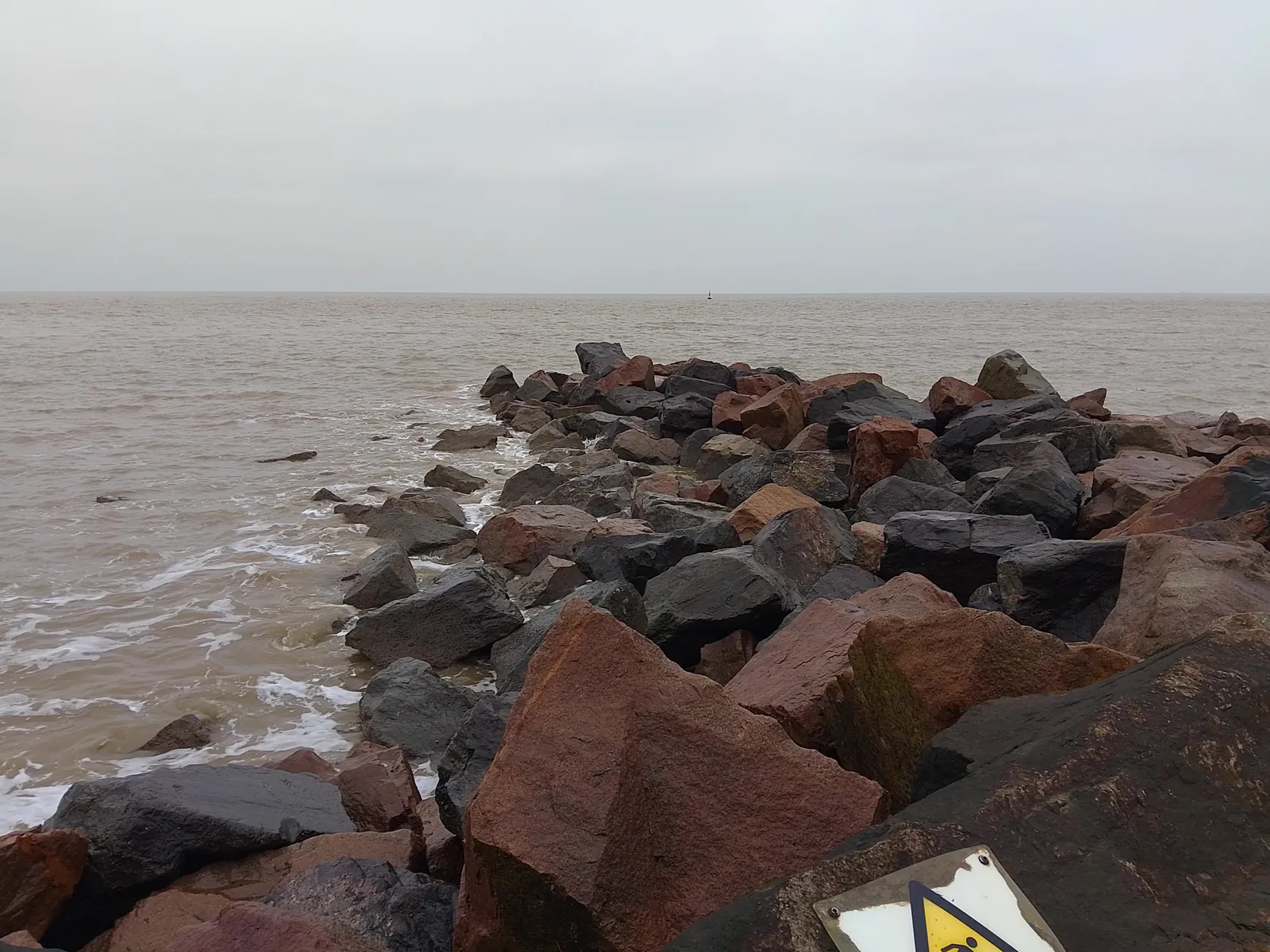
Anyone asking what is rip rap, or what is riprap, is asking about the same material: heavy broken stone, graded by size and laid as a blanket over a bank, shoreline or channel so that moving water hits rock instead of soil. Engineers call the finished layer a revetment. The U.S. Army Corps of Engineers sorts shoreline structures by shape: vertical structures are seawalls or bulkheads, and protective material laid on a slope is a revetment (Source: USACE Engineer Manual 1110-2-1614, Design of Coastal Revetments, Seawalls, and Bulkheads).
The names vary more than the product does. Rip rap rock, rip rap stone, riprap rock, armor stone and revetment stone all describe the same thing on a quote. What matters is the specification behind the name: the stone size class, the layer thickness, the filter underneath and how the bottom edge is anchored.
This page explains the material and how a revetment is put together. For pricing by the ton and by the foot, see the riprap cost guide. To turn a bank length and height into tons and cubic yards, use the rip rap calculator.
How riprap stops erosion
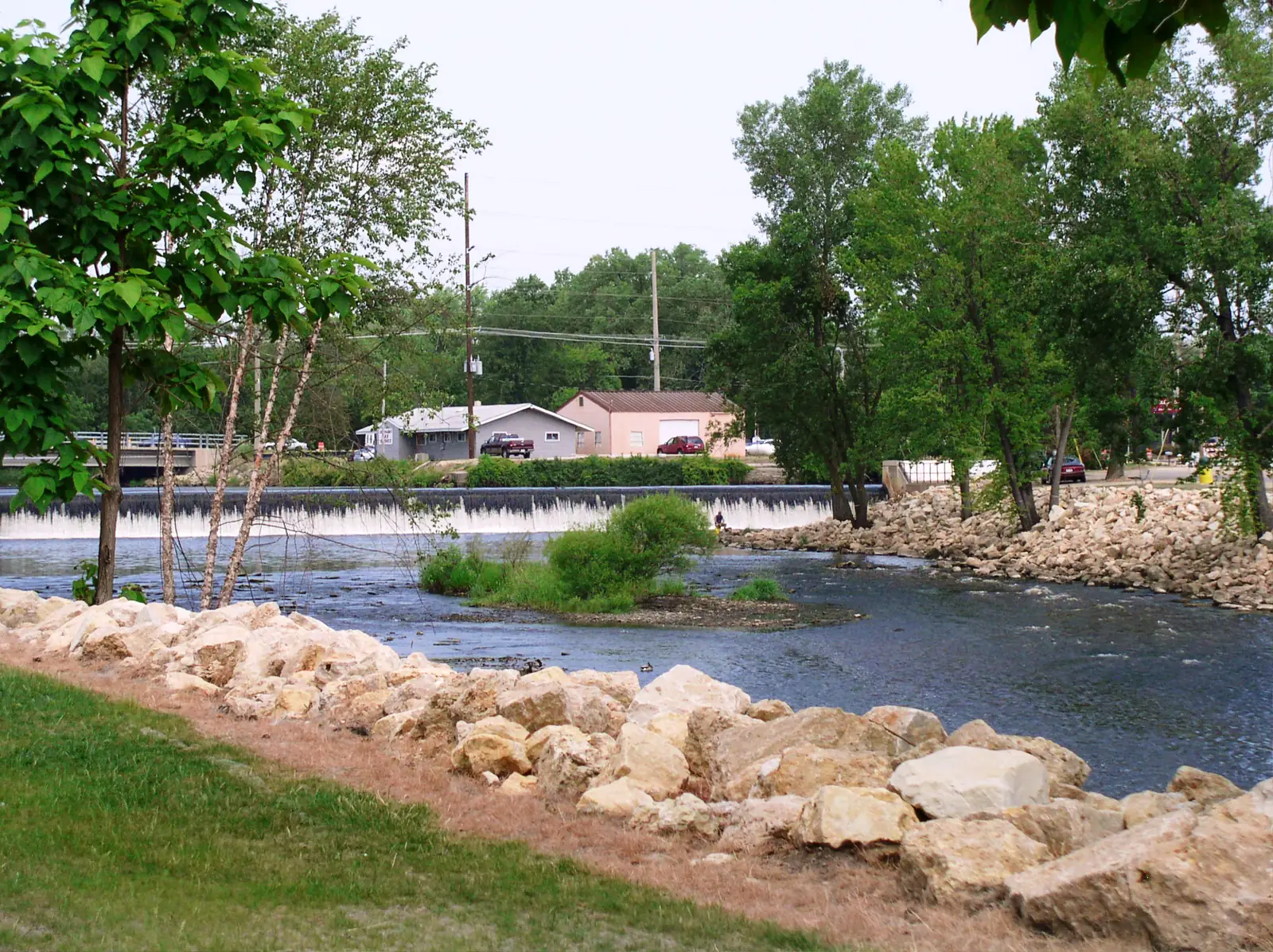
A bank erodes when moving water pushes on a soil particle harder than the particle can resist. Riprap changes both sides of that contest. Each stone is too heavy for the design wave or current to move, and the rough, open surface breaks a wave into turbulence inside the gaps between stones instead of letting it run up a smooth face.
A vertical wall reflects wave energy back into the water, which is why the base of a seawall scours. A rock slope dissipates much of that energy inside the layer.
The second property is flexibility. Because riprap is placed several stones thick, it adjusts to settlement and local displacement without the whole installation failing. The Federal Highway Administration calls this a self-healing characteristic (Source: FHWA Hydraulic Engineering Circular No. 23, Design Guideline 4, Riprap Revetment).
There is one thing riprap does not do. The same guideline states that revetments give no resistance against geotechnical instability, such as slumping failure in a saturated bank. If a slope is sliding because groundwater is building up inside it, rock on the face will ride down with the slide. That problem starts with drainage, covered under yard drainage solutions.
Where riprap is used
- Lake and pond shorelines. The most common residential use: a sloped bank armored against wind waves, boat wake and, in the north, ice.
- River and stream banks. Especially the outside of bends, where the federal sizing method applies a higher velocity factor than on a straight reach.
- The base of a seawall or bulkhead. Rock placed at the toe breaks up the energy that undermines the wall. It is often the real fix in seawall repair.
- Bridge abutments, culvert outlets and drainage channels. Anywhere concentrated flow leaves a pipe or squeezes past a structure.
- Yard-scale outlets. A few square feet of small stone where a downspout line or a French drain daylights is the same idea at a smaller size.
Rip rap rock: stone type and shape
Riprap is quarried, not collected. Limestone, granite and basalt are the usual sources, and local geology decides which one is cheap in a given county. Four properties matter more than the rock name.
Angularity. Federal guidance prefers subangular to angular stone because it interlocks, and interlocked stone is more stable than rounded stone of the same weight. The sizing method behind that guidance uses a stability coefficient of 0.30 for angular rock and 0.375 for rounded rock, so rounded stone has to be about 25 percent larger to resist the same flow. Rounded cobble belongs in a planting bed, sized with the river rock calculator, not on a shoreline.
Shape. Stones should not be thin and platy or long and needle-like. The recommended limit is a longest dimension no more than three times the thickness.
Density. A minimum specific gravity of 2.5 is typical for riprap, and 2.65 is the usual design value. That is about 165 pounds per cubic foot of solid rock. Lighter stone has to be larger to do the same work.
Durability. Good riprap breaks only with difficulty, has no earthy odor, has no closely spaced joints or bedding planes and does not absorb water easily. (Source for this section: FHWA Hydraulic Engineering Circular No. 23, Design Guideline 4).
New York Sea Grant gives a practical example of why the rock type matters: sandstone that works in an inland retaining wall may be too light for wave energy and will round off and move more easily than a denser, more angular dolomite (Source: New York Sea Grant, Guidelines for Selecting a Marine Contractor).
Broken asphalt and construction debris are not riprap. The general conditions of the Army Corps nationwide permits bar unsuitable material, and they name trash, debris, car bodies and asphalt as examples.
Rip rap stone sizes and classes
Riprap is sold as a graded mix, not as stones of one size. The mix is described by its median stone size, written d50: half the material by weight is smaller and half is larger. A well-graded mix matters because the smaller stones fill the gaps between the larger ones and lock the layer together.
The Federal Highway Administration publishes ten standard classes, adopted from National Cooperative Highway Research Program Report 568. Each class is named for its median size, and the largest stone allowed in each class is twice that size.
| Class | Median stone size | Largest stone | Median stone weight | Typical use |
|---|---|---|---|---|
| I | 6 in | 12 in | 20 lb | Low-energy pond and lake banks, small channels |
| II | 9 in | 18 in | 60 lb | Low-energy pond and lake banks |
| III | 12 in | 24 in | 150 lb | Standard residential shoreline |
| IV | 15 in | 30 in | 300 lb | Standard residential shoreline |
| V | 18 in | 36 in | 1/4 ton | Standard shoreline with more exposure |
| VI | 21 in | 42 in | 3/8 ton | Exposed shoreline, river bends |
| VII | 24 in | 48 in | 1/2 ton | High wave or ice exposure |
| VIII | 30 in | 60 in | 1 ton | High wave or ice exposure |
| IX | 36 in | 72 in | 2 tons | High wave or ice exposure |
| X | 42 in | 84 in | 3 tons | Engineered projects beyond residential scale |
The sizes and weights are the federal figures. The typical-use column is a guide only: it follows the size bands in this site's cost calculator (6 to 12 inches for low energy, 12 to 18 for standard shoreline, 24 to 36 for high wave or ice) and does not replace sizing.
Two cautions. First, class numbers are not universal. State agencies keep their own lists; North Carolina's erosion control manual, for example, uses classes A, B, 1 and 2. Compare quotes by median size in inches, not by class label. Second, the class is an output of design, not a preference. For rivers and channels, the federal method sizes stone from flow velocity and depth and applies a safety factor of at least 1.1, with more where ice or debris impact is likely. For lakes and coasts, where waves do the work, the Corps of Engineers sizes armor stone from the design wave height. Bigger is not automatically better: a larger class needs a thicker layer and more tons per foot.
The layers: filter, bedding, armor and toe
A revetment is a system of layers, and the rock on top is only the visible one.
- Graded bank. The slope is cut back to a stable angle and smoothed so the filter sits flat against the soil.
- Filter. Either a geotextile or a layer of graded stone. Its job is to hold the bank soil in place while letting water pass freely in both directions. Where a granular filter is used, FHWA sets the minimum thickness at four times the median size of the filter stone or 6 inches, whichever is greater, and 50 percent more if it is placed under water. Residential work normally uses a non-woven geotextile.
- Bedding. On larger stone classes, a layer of smaller bedding stone is often placed over the fabric before the armor goes on. FHWA's guidance is that riprap should be placed on bedding stone, a geotextile filter, or both.
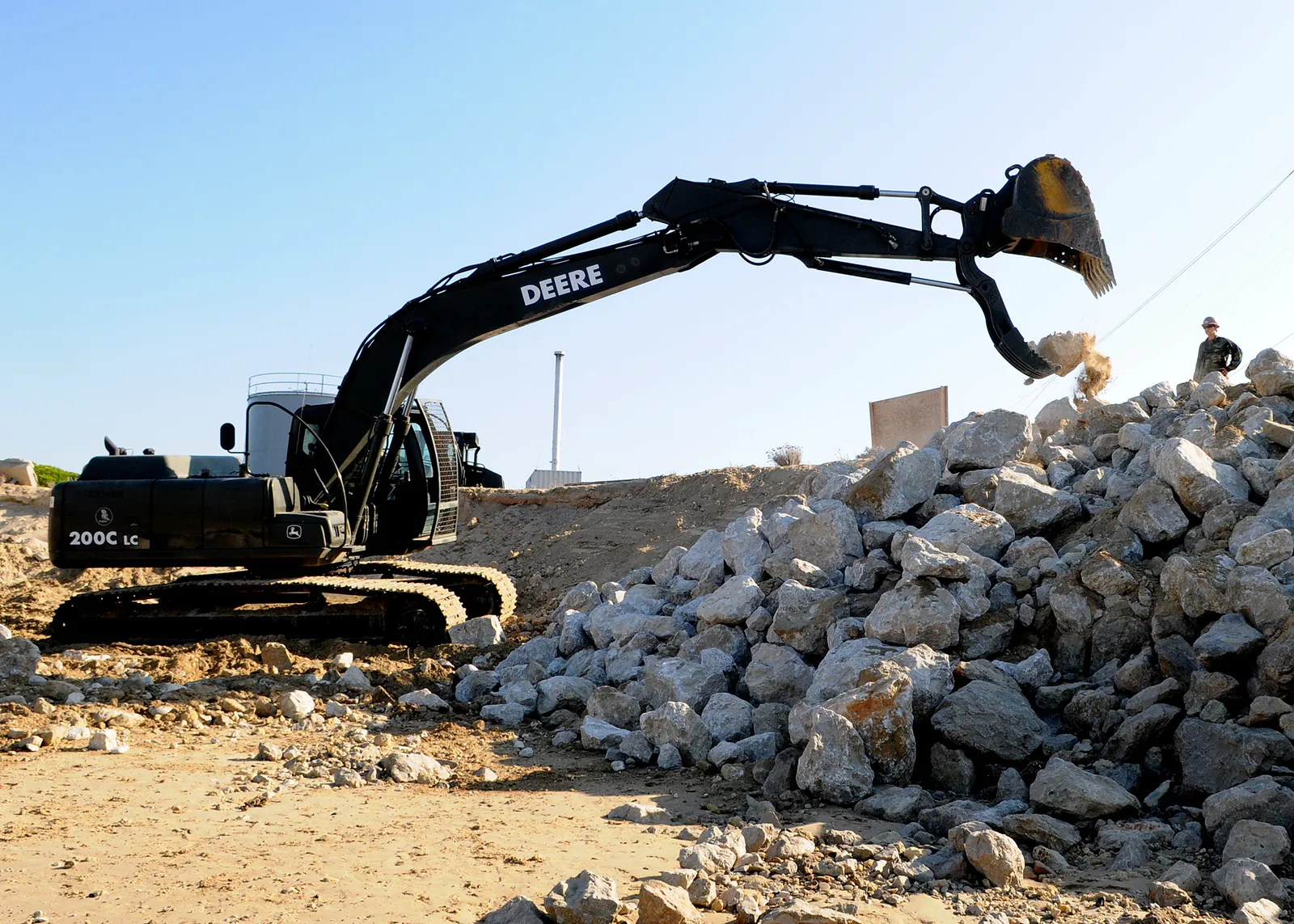
- Armor layer. The riprap itself. The mix has to stay mixed: FHWA's guideline says segregation of the stone by size during hauling, dumping or off-loading is not acceptable, and that the finished surface should be dense, rough and well keyed, with voids minimized. In practice that means placing stone with an excavator, not tipping it down the bank.
- Toe. The bottom edge is carried down below the depth the bed is expected to scour, or built as a mound of extra stone that settles into a scour hole as it forms. A revetment that simply stops at the existing bottom is undermined first at that edge.
- Ends and top. The upstream and downstream ends are keyed into trenches so water cannot get behind the layer, and the stone is carried at least 2 feet above the design high water level.
The filter is the layer most often left out, because the rock looks like the important part. FHWA's wording is that the importance of the filter component should not be underestimated. Without it, fine soil is drawn out through the gaps and the bank hollows out under stone that has not moved (Source for this section: FHWA Hydraulic Engineering Circular No. 23, Design Guideline 4, sections 4.2.6 and 4.2.7).
Slope and thickness limits
Slope. Two feet of horizontal run for each foot of rise, written 2:1, is the usual limit for residential riprap without engineering. The FHWA guideline's standard details show 1.5:1 as the steepest slope for a riprap revetment. Steeper than that, stone will not stay put, and the bank has to be cut back or held with a wall.
Slope decides whether rock fits a lot at all. At 2:1, a five-foot bank takes about ten feet of horizontal space.
Thickness. The recommended criteria are a layer no thinner than the largest stone in the mix and no thinner than 1.5 times the median stone, whichever is greater; never less than 1 foot; and 50 percent thicker where the stone is placed under water (Source: FHWA Hydraulic Engineering Circular No. 23, Design Guideline 4, section 4.2.3). Because the largest stone in each standard class is twice the median, that works out to a layer about two median stones thick: roughly 12 inches for 6-inch stone, 24 inches for 12-inch stone and 36 inches for 18-inch stone.
Thickness drives tonnage. Placed riprap runs about 1.35 to 1.5 tons per cubic yard, and a typical residential lakeshore needs about 1.1 to 1.9 tons per linear foot. The riprap tonnage calculator works that out from bank height, slope and layer thickness, and the general rock calculator handles bedding stone and smaller jobs.
Riprap vs a seawall
The two solve the same problem in opposite ways. A wall holds a vertical edge and reflects energy; rock gives up yard to a slope and absorbs it.
- Cost. Riprap runs $80 to $300 per linear foot installed, against $150 to $650 for a seawall, which is typically 40 to 60 percent less for the same length. The seawall cost guide has the wall side of that comparison.
- Footprint. A wall takes almost no yard. Rock takes the full width of the slope.
- Use of the edge. Rock does not give a walkable edge or a place to tie up a boat. A wall does.
- Permitting. Agencies generally prefer sloped, permeable rock to vertical hard armor, and several states exempt short runs of riprap from individual permits.
The two are often combined. Rock at the base of a vinyl seawall or a timber bulkhead protects the toe, and replacing a failed wall with a rock slope is a common alternative to rebuilding it where the lot has room. The seawalls, bulkheads and riprap hub walks through that choice.
Permits and environmental basics
Placing rock at or below the waterline is regulated work on most water bodies. The Army Corps of Engineers regulates structures and work in navigable waters under Section 10 of the Rivers and Harbors Act of 1899, and the discharge of fill material into waters of the United States under Section 404 of the Clean Water Act. Riprap is fill.
Most residential riprap is authorized under Nationwide Permit 13, Bank Stabilization, which lists rip rap by name. As reissued effective March 15, 2026, its main limits are:
- no more than 500 feet in length along the bank;
- no more than an average of one cubic yard of material per running foot placed below the ordinary high water mark or the high tide line;
- no material placed beyond the minimum needed for erosion protection;
- no material placed where it will be eroded by normal or expected high flows.
A project that goes over the length or volume limit, or that places fill in a special aquatic site such as a wetland, needs a pre-construction notification to the Corps district and a written waiver before work starts (Source: Nationwide Permit 13, Federal Register, January 8, 2026). State and local permits apply on top, and some states publish their own exemptions for short runs of shoreline rock.
The same permit encourages soft approaches, such as planting and bioengineering, on banks exposed to low or moderate erosive forces, and accepts hard armor where forces are strong. Who files the paperwork is covered in the guide to hiring a seawall contractor.
Lifespan and maintenance
Sound stone does not rot, rust or get eaten by marine borers, so riprap has no material clock the way timber or steel does. Its life is set by the three decisions that are invisible on completion day: stone sized for the site, a layer thick enough, and a filter under it. A revetment that gets those right needs attention every few years, not every season.
Maintenance is part of the permit, not an extra. Nationwide Permit 13 requires the work to be properly maintained, which it notes may mean repairs after severe storms or erosion events, and it authorizes those repairs.
After a major storm, a flood or a hard ice-out, walk the bank and look for:
- stone that has rolled downslope or collected at the bottom;
- bare filter fabric showing between stones;
- a dip or slump in the surface, which means soil is leaving from underneath;
- a hollow at the toe, or stone missing along the waterline;
- erosion at either end, where water is working behind the layer.
Displaced stone can be reset and thin spots topped up with the same class. A slump is different: it means the filter or the toe has failed, and adding rock on top will not stop it. A shoreline inspection can tell the two apart, and the seawall construction guide shows how rock toe protection is built in when a wall goes up.
Common questions
What is rip rap used for?
Rip rap is used to stop moving water from eroding soil. Common uses are lake and pond shorelines, river and stream banks, the base of seawalls and bulkheads, bridge abutments, culvert outlets and drainage channels. In each case the stone takes the force of waves or current, and a filter layer under it keeps the soil from washing out through the gaps.
What size rip rap rock do I need?
Size is set by the force of the water, not by preference. Riprap is specified by median stone size: the Federal Highway Administration's standard classes run from 6 inches (Class I) to 42 inches (Class X). Sheltered pond and lake banks commonly use 6 to 12 inch stone, standard shoreline 12 to 18 inch, and wave or ice exposure 24 inches and up. An engineer or experienced marine contractor should confirm the class.
Do you need fabric under riprap?
Yes, or a graded stone filter that does the same job. Rock alone does not stop fine soil from migrating out through the gaps, so the bank washes out from underneath while the stone still looks intact. Federal Highway Administration guidance allows either a geotextile or a granular filter under riprap and says the importance of the filter should not be underestimated.
How steep can a riprap slope be?
Two feet horizontal for every foot of rise (2:1) is the usual limit for residential work without engineering. The Federal Highway Administration's design guideline for riprap revetment shows 1.5:1 as the steepest slope in its standard details. A bank steeper than that has to be cut back before stone goes on, or held with a vertical structure instead.
Can you use river rock instead of riprap?
Not as a substitute at the same size. Rounded stone does not lock together the way angular quarried stone does. The federal sizing method assigns rounded rock a stability coefficient of 0.375 against 0.30 for angular rock, which means rounded stone has to be about 25 percent larger to resist the same flow. River rock is a landscape material; riprap is a structural one.