Guide
French drains in a yard
A yard drain is the cheapest French drain to build and the easiest to build for the wrong problem. Find where the water comes from before deciding where the trench goes.
Short answer: A French drain in yard soil is a trench 18 to 24 inches deep, lined with fabric and filled with washed stone around a perforated pipe, sloped at least 1% to a lower outlet. It dries lawns kept wet by water in the soil. Installed runs cost $18 to $40 per linear foot.
On this page
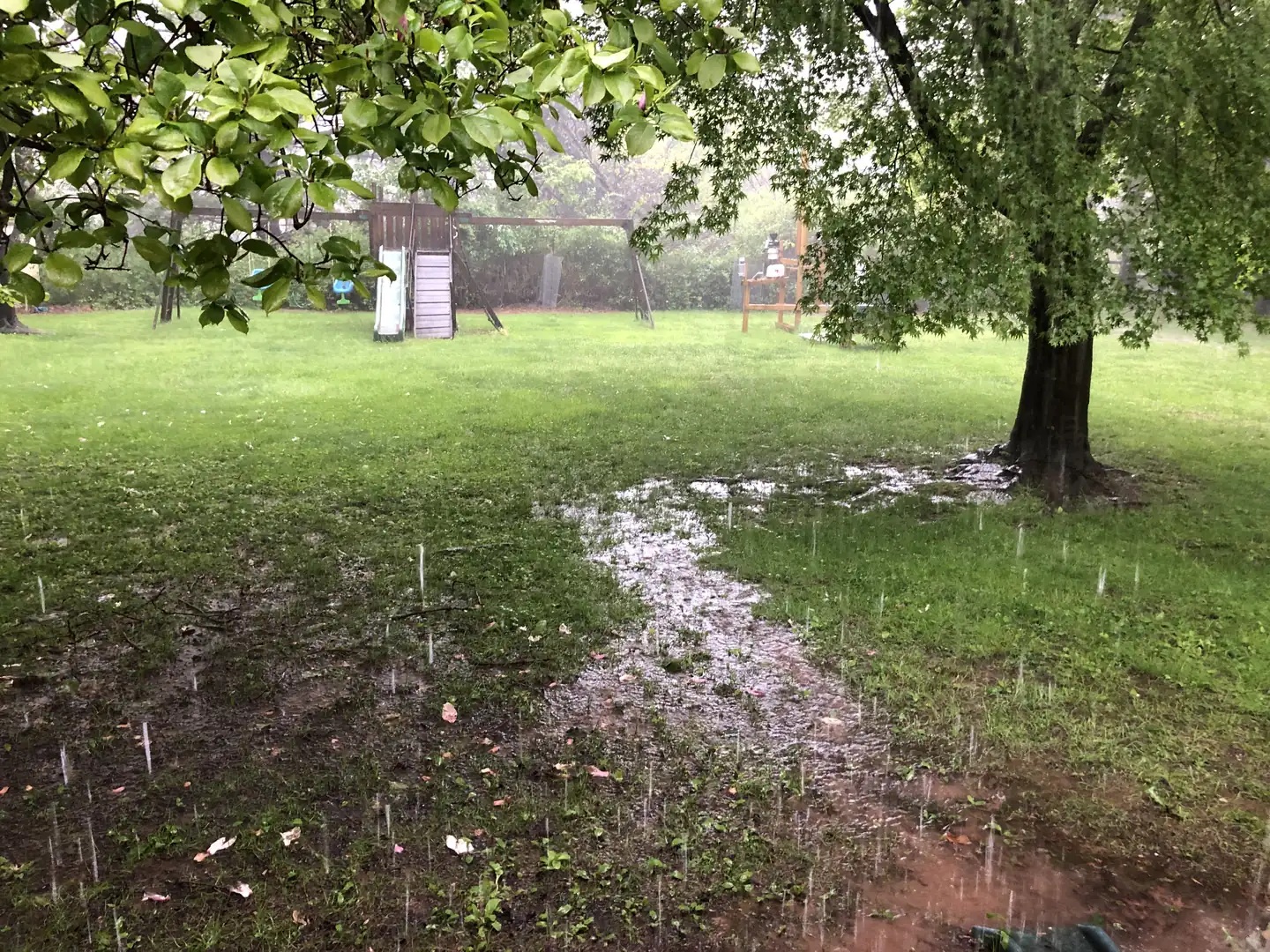
Standing water and a lawn that never firms up have several causes, and a trench only fixes some of them. This page starts with the diagnosis, then covers route, outlet, slopes, catch basins and putting the lawn back. The mechanism itself is explained in the French drain guide.
Diagnose the source first
Go outside during a steady rain and again the morning after. Where the water comes from, and how long it stays, decides the fix.
| Source | How to recognize it | First fix |
|---|---|---|
| Downspouts | The wet area is downhill of a downspout or splash block, and it is wet only after rain | Extend the downspout or pipe it in solid pipe to a better spot |
| Grading | Water runs toward the house or sits on a flat shelf beside it | Regrade so the surface falls away |
| Low spot | A bowl that fills from the surface and holds a puddle for days | Fill and regrade, or a catch basin at the low point |
| Hillside runoff and seepage | Wet along the foot of a slope, sometimes days after rain, sometimes with no rain at all | Curtain drain across the slope |
| Saturated soil | Soft, squelching ground over a wide area with no obvious surface flow | French drain through the wet zone to a lower outlet |
The first two rows cost the least and get skipped the most. A downspout extension is a $40 part. A meaningful share of jobs sold as a French drain for yard flooding are roof water landing in the wrong place. Near the house, the International Residential Code standard is ground that falls at least 6 inches within the first 10 feet from the foundation (Source: International Residential Code, section R401.3). If your yard fails that test, fix the grade before trenching.
If the water is reaching the basement and not just the lawn, the problem is one step further along. Start with the foundation and basement water guide.
When a yard French drain is the right tool
A French drain collects water along a line and moves it by gravity. It works when three things are true.
- The water is in the soil. Water migrates into the open stone from saturated ground beside it. That is the job the trench was invented for.
- There is somewhere lower to send it. A drain with no outlet is a trench that fills and stays full.
- The cheaper causes are ruled out. Downspouts moved, grade checked.
It is the wrong tool for a puddle fed entirely from the surface on tight soil. Surface water needs a surface inlet. That is the difference covered in French drain vs dry well and catch basin.
Choose the outlet, then the route
Design a yard French drain backward. The outlet comes first, because it sets the depth and direction of everything upstream.
Outlet options
- Daylight. The pipe surfaces on a downslope and water runs out. Free and passive. It needs the fall to exist: at least 1 foot of drop per 100 feet of run between the wet area and the outlet.
- Dry well. A buried stone or chambered reservoir that lets water soak in. For lots with no fall and soil that drains. $1,500 to $4,000.
- Storm sewer or curb. Only where the municipality permits it. Ask before designing around it.
Three places the pipe must not end: on a neighbor's property, which can create legal liability; in or across a septic drain field; and in a sanitary sewer.
Route
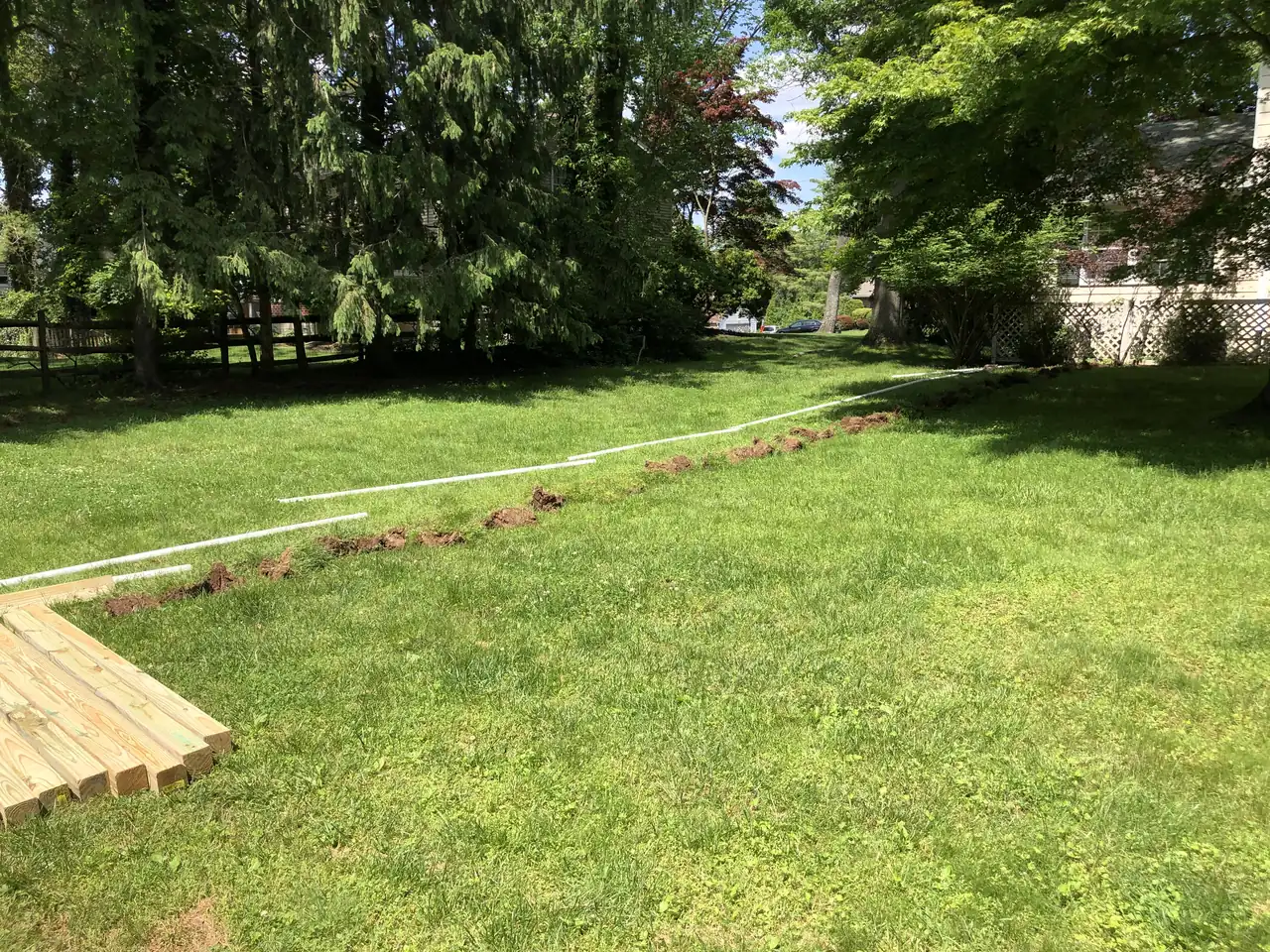
Run the trench through the wettest ground, or along its uphill edge when the water arrives from one side, and take the shortest path to the outlet that keeps a continuous downhill grade. The switch from perforated pipe to solid pipe happens where the line leaves the wet zone; from there to the outlet it only carries.
Check the fall before digging. A string line and a line level, or a rented laser level, will tell you whether the outlet is actually lower than the wet area and by how much. A lawn that looks like it slopes often does not. The depth and slope guide shows the measurement and the arithmetic.
Keep the route out of the root zone of mature trees, and call 811 before the first cut. Utility locates are free and required in most states, and 18 to 24 inches is deep enough to reach buried services.
Curtain drains for slopes
When the yard is wet because water is coming down a hillside, on the surface or through the soil, the fix is to cut it off before it arrives. A curtain drain, also called an interceptor drain, is a French drain laid across the slope on the uphill side of the area to protect.
Stormwater practice for interceptor drains is consistent on layout: they are installed perpendicular to the slope, on the upslope side of the wet area, and they discharge to the side of the slope (Sources: Washington State Department of Ecology stormwater manual, BMP C205, Subsurface Drains; Greenville County, South Carolina, subsurface drain specification RC-02). They are usually a single line, not a grid.
A curtain drain goes deeper than a lawn drain, 2 to 3 feet, because it has to reach the layer the water is traveling through. That is commonly the top of a clay or hardpan layer under more open soil. It still needs fall along its length, so it runs slightly diagonal to the contours and exits around the end of the area it protects.
Installed, a curtain drain runs $25 to $55 per linear foot. Start with one line. Add a second lower down only if seepage continues below the first.
Combining a French drain with catch basins
A French drain takes in water slowly along its length. A catch basin takes in surface water fast at one point. Many yards need both: a basin at the low spot where the puddle forms, and a French drain through the ground that stays soft.
- Set the basin at the true low point, with the grate slightly below the surrounding lawn so water runs to it.
- Use a basin with a sump. The space below the outlet pipe traps leaves, grit and sediment before they reach the pipe. Clean it out before it fills.
- Carry basin water in solid pipe. Surface water arrives in volume and carries debris. Sending it down the perforated line pushes water back out into the soil you are draining and silts the stone.
- Keep downspouts in their own solid pipe for the same reason. The lines can share an outlet. They should not share the perforated section.
Build specification
The yard version is the simplest French drain to build, and the same few details decide whether it lasts.
| Element | Specification |
|---|---|
| Depth | 18 to 24 inches; 2 to 3 feet for a curtain drain |
| Trench width | 12 to 18 inches |
| Slope | Minimum 1%: 1 foot of fall per 100 feet, or 1 inch per 8 feet |
| Pipe | 4-inch perforated, rigid where the budget allows, holes down |
| Stone | Washed, angular, 3/4 inch, with no fines |
| Fabric | Non-woven geotextile lining the trench and wrapped over the stone |
The reasoning behind each line is in the pipe, gravel and fabric guide, and the step-by-step build is in how to install a French drain. For quantities, the French drain gravel calculator turns trench length, width and depth into cubic yards and tons of stone.
Two additions cost little during the build and pay for themselves later: a cleanout riser at the high end so the pipe can be flushed, and a grate on the outlet so animals do not nest in it. Both are covered in French drain maintenance.
Restoring the lawn
A trencher leaves a strip of bare, disturbed ground and a pile of spoil roughly equal to the stone that went in. Plan for both.
- Save the sod. Cut it in strips before trenching and keep it shaded and damp so it can go back as soon as the trench is closed.
- Decide how the trench finishes. Stone to the surface takes in the most surface water and stays visible. Fabric folded over the stone, then topsoil and turf, hides the drain and still collects water from the soil.
- Use topsoil over the fabric, not the clay you dug out. Dense subsoil over the trench seals it from above.
- Dispose of the spoil. Spread it thin in a place that needs raising, or have it hauled. Do not mound it along the trench, where it will dam surface flow.
- Expect settlement. The strip sinks a little over the first season. Top-dress with soil and reseed.
With no restoration at all you will have a strip of bare, settled soil for a season. Sod or seed over the line is a small addition to the job and is usually worth pricing in.
Where a rain garden or regrading is the better fix
A French drain moves water. Two other fixes deal with it more cheaply in the right conditions.
Regrading. If the wet area is a low spot fed from the surface, filling it and shaping the ground so water runs off is permanent, has no pipe to clog and needs no outlet structure. A shallow grassed swale does the same for water crossing the yard: it gives surface flow a defined path to the edge of the lot. Regrading is the first choice wherever the problem is the shape of the ground and not water in the soil.
A rain garden. If the water is roof or driveway runoff and the soil drains, a planted basin that holds the water and lets it soak in within 24 to 48 hours removes it from the yard entirely instead of relocating it. The rain garden guide covers siting and sizing, and the rainwater collection calculator shows how many gallons a roof sheds in a storm.
Neither works where the soil is saturated from below or water is seeping out of a hillside. Those are French drain problems. For the full menu, see the overview of yard drainage solutions.
What a yard French drain costs
Installed by a contractor, a yard French drain runs $18 to $40 per linear foot: $900 to $2,000 for a 50-foot run and $1,800 to $4,000 for 100 feet, before the outlet and restoration. Daylight is free. A dry well adds $1,500 to $4,000.
This is the one placement where doing it yourself is realistic. Materials come to $6 to $16 per foot, and a rented trencher handles a shallow run with good access. The contractor's price is mostly labor, machine time, spoil removal and the assurance that the pipe actually falls toward the outlet.
The French drain cost calculator prices a run by length, soil, access and outlet, and you can request quotes on the French drain cost page to check a bid against it.
Common questions
Will a French drain fix a soggy yard?
It will if the lawn is wet because water is moving through the soil or sitting in it with nowhere to go, and there is a lower point to drain to. It will not fix a yard that is wet because a downspout empties onto it, because the grade tilts the wrong way, or because there is no outlet lower than the wet area.
How deep should a French drain be in a yard?
A yard French drain is usually 18 to 24 inches deep and 12 to 18 inches wide. A curtain drain intercepting water from a slope goes deeper, 2 to 3 feet. More important than the depth is the fall: the trench bottom must slope continuously at 1% or more, which is 1 foot of drop per 100 feet of run.
Where should a yard French drain end?
At a point lower than the trench where the water can leave without causing a new problem. The best outlet is daylight on a downslope within your own lot. Where there is no fall, a dry well in soil that drains is the usual alternative. It should never end at a neighbor's property line, a septic drain field or a sanitary sewer.
How much does a French drain for a yard cost?
A contractor-installed yard French drain costs $18 to $40 per linear foot, so $900 to $2,000 for a 50-foot run and $1,800 to $4,000 for 100 feet. A curtain drain on a slope runs $25 to $55 per foot. Doing a shallow run yourself costs $6 to $16 per foot in materials.
Can you put grass over a French drain?
Yes. Fold the fabric over the top of the stone, add topsoil and lay sod or seed. The drain still collects water moving through the soil. It collects less surface water than a trench with stone to the surface, so where puddles are the problem, leave the stone exposed or add a catch basin at the low spot.