Guide
Vinyl seawalls
Vinyl sheet pile is the default material for residential seawalls and bulkheads. It does not rust or rot, but it is far less stiff than steel, and that one property decides where it belongs.
Short answer: A vinyl seawall is a wall of interlocking PVC sheet piles driven into the bottom, tied back to buried anchors and finished with a cap. It does not rust or rot. It costs $200 to $450 per linear foot installed and suits sheltered water with an exposed height up to about 6 to 7 feet.
On this page
What is a vinyl seawall?
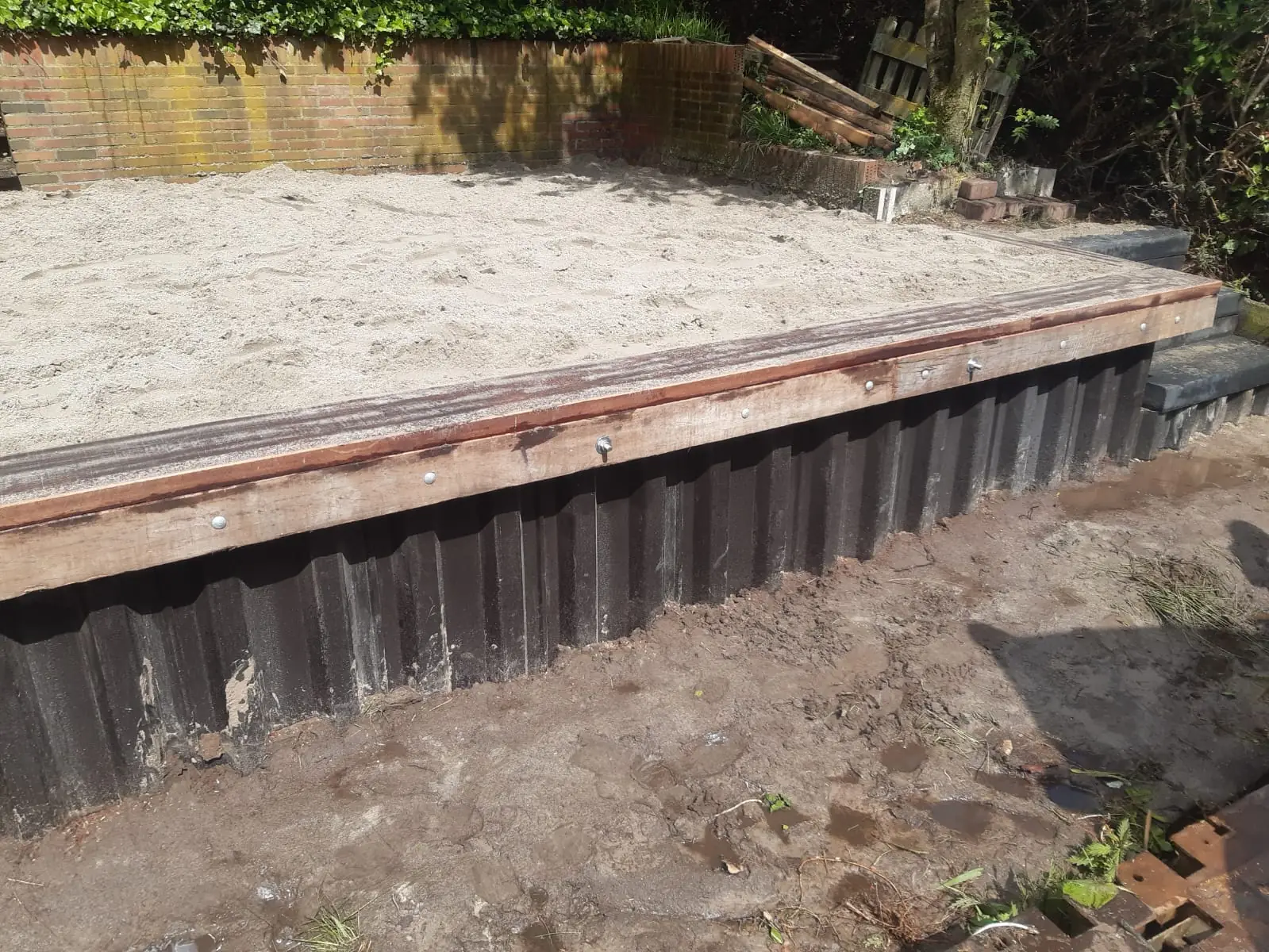
A vinyl seawall is a sheet pile wall made of rigid PVC instead of steel, timber or concrete. Long corrugated sheets are driven edge to edge into the bottom to form a continuous face. The upper part holds back the soil; the buried part holds the wall. A horizontal beam and a row of tie rods anchor the top back into the yard, and a cap finishes the heads of the sheets.
The sheets are made by continuous extrusion. According to U.S. Army Corps of Engineers guidance, manufacturers commonly use recycled PVC for the core of the sheet, about 90 percent of its volume, and a thin outer layer of UV-protected virgin PVC, called capstock, for weather resistance (Source: USACE Engineering and Construction Bulletin 2017-4, Interim PVC Sheet Pile Guidance). For years there was no product standard for vinyl sheet piling. There is now: ASTM D8427, Standard Specification for Rigid PVC Exterior Profiles Used for Sheet Piling, published in 2021.
Whether the finished wall is called a seawall or a bulkhead depends on the region and the exposure. The seawalls, bulkheads and riprap hub explains the difference. In most of the places vinyl is the right material, the wall is doing a bulkhead's job: holding soil in calm water.
How vinyl sheet piling interlocks and is driven
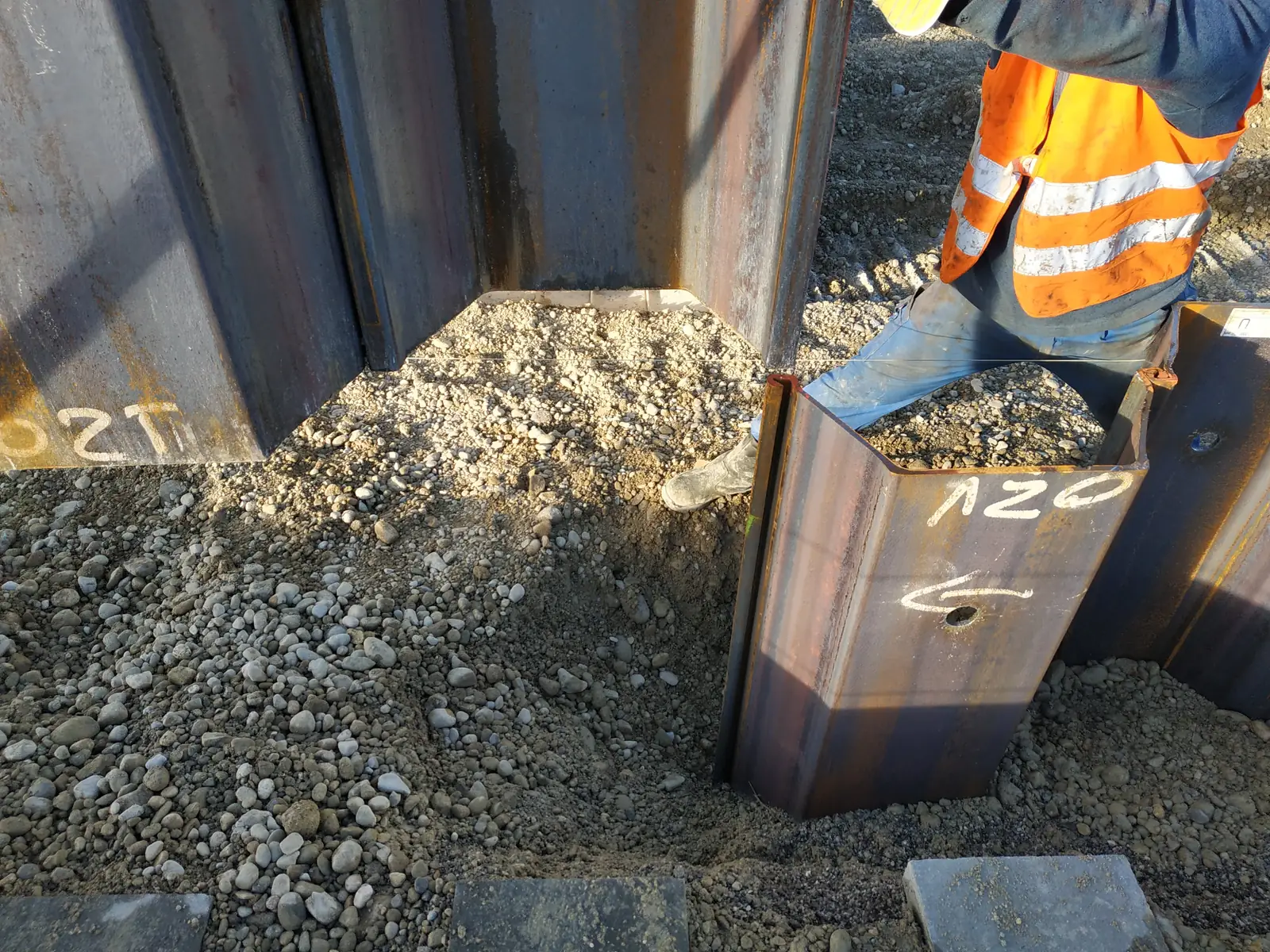
Each sheet has a male edge and a female edge. The next sheet slides down the edge of the one before it, so the joint is locked for the full height of the wall. The federal guide specification for synthetic sheet piling requires the interlocks to slide freely when the sheets are plumb, and requires driven sheets to be interlocked throughout their length so the wall forms a continuous diaphragm. It also prohibits splicing: each sheet is one full-length piece (Source: Unified Facilities Guide Specification 31 41 16.16, Synthetic Sheet Piling).
The sequence on site:
- Set a guide. A temporary frame or template holds the sheets on line and vertical. Vinyl sheets are flexible and wander without one. The guide specification allows no more than 1/8 to 1/4 inch out of plumb per foot of length.
- Thread and start each sheet. A sheet is lifted, its interlock is threaded into the previous sheet, and it is set into the bottom.
- Drive in stages. A vibratory hammer, often mounted on an excavator, works the sheets down. Sheets are driven alternately in increments, not one at a time to full depth, so no sheet's tip gets far ahead of its neighbors.
- Reach design depth. Driving stops at the tip elevation on the drawings. A sheet that stops short has less embedment than the design assumed. The guide specification calls for the obstruction to be removed or penetrated, or the design changed as directed, so it is a question for the designer and not a field shortcut.
- Cut to grade. The heads are trimmed to a level line ready for the cap.
Vibratory hammers work best in sandy and granular soils and also work in silts and softer clays. Stiff clay, dense sand, rock and buried debris are harder. In those conditions contractors use a steel mandrel, a full-length steel cradle that is driven with the sheet and then pulled out, or pre-punch the line with a steel beam, or fit tip protection to the sheet. Sustained vibration against a hard layer can melt or damage the interlocks, so the guide specification calls for stopping when penetration drops below one foot per minute (Sources: USACE Engineering and Construction Bulletin 2017-4; Unified Facilities Guide Specification 31 41 16.16).
How deep the sheets go is set by a soil probe. The part below the mudline is usually as long as the part you can see, sometimes twice. The full build sequence, including permits and access, is in the seawall construction guide.
The cap, wale and tieback system
The sheets are the least structural part of a vinyl wall. PVC has low strength and low stiffness compared with steel, and it creeps: it keeps deforming slowly under a steady load. Corps guidance therefore limits the allowable bending stress in PVC sheet pile to 3,200 psi, about half of its 6,500 psi tensile strength, so that stresses stay below the creep limit for the life of the wall. It also notes that an unanchored vinyl wall is controlled by how much it deflects, not by how strong it is, and that it is typically more economical to design vinyl as an anchored wall.
The anchoring system has four parts.
- Wale. A horizontal beam bolted along the wall near the top. It is also written waler or whaler. It spreads the pull of each tie rod across many sheets so no single sheet carries a point load.
- Tie rod. A steel rod that passes through the wale and the sheet and runs back into the yard. Residential walls typically place them at 6 to 10 foot centers.
- Anchor. A buried block, plate or pile at the far end of the rod, often called a deadman. It only works if it sits in soil the wall is not already pushing on. Anchors placed inside the wedge of soil that moves with the wall show little holding value (Source: Caltrans Trenching and Shoring Manual, chapter on anchors).
- Cap. A cover over the sheet heads that keeps them in line and gives a finished edge. The federal guide specification allows caps of PVC, aluminum, reinforced concrete or wood.
Almost any wall over about four feet of exposed height needs tiebacks. A quote for a six-foot vinyl wall without them is not a cheaper wall; it is a shorter-lived one.
Two smaller details carry as much weight. The backfill behind the sheets has to drain freely, with filter fabric to keep soil from leaving through the joints and weep holes where the design calls for them. And the ends of the wall need return walls that turn back into the bank, because water that gets around the end of a wall removes the soil behind it. Corners should be gentle: Corps guidance warns that sharp corners in vinyl can pull the interlocks apart as the wall flexes.
Where vinyl works
- Canals, protected coves, inland lakes and ponds. Calm water where the wall retains soil and does not take direct wave attack.
- Salt and brackish water. PVC does not corrode, and marine borers do not feed on it. Those are the two things that shorten steel and timber in salt water.
- Exposed heights up to about 6 to 7 feet. That is the practical ceiling for residential vinyl sections.
- Drivable soils. Sand, silt and soft to medium clay with no shallow rock.
- Tight sites. The sheets are light enough that many jobs can be built from land with an excavator, which avoids barge cost.
Where vinyl does not work
High wave energy. Open water with direct wave exposure is seawall territory in the engineering sense, and it calls for steel or concrete. If a contractor proposes vinyl on open water with a tall bank, ask for the engineering that justifies it.
Impact and ice. PVC sheet pile has low impact resistance compared with steel, and that resistance declines with age. Corps guidance says PVC sheet pile shall not be used where large debris, vessel or ice impact is possible during the design life. Northern lakes with moving ice are a poor fit.
Tall walls. Above about 6 to 7 feet of exposed height, deflection governs and the design moves to steel. The federal guide specification describes PVC and fiberglass sheet together as suited to exposed heights under 20 feet, but that is an upper bound for engineered, anchored designs. The practical ceiling for residential vinyl stays around 6 to 7 feet.
Hard bottom. A vinyl wall needs embedment. Where rock or a dense layer sits close to the mudline, the sheets cannot reach design depth, and driving aids only go so far. That condition needs a different wall type and an engineer's design.
Heavy loads behind the wall. A driveway, pool deck or building footing close behind the wall adds load the sheets were not sized for. It forces an engineered design whatever the material.
Where the bank can slope, rock is the other alternative. Riprap takes more yard but handles wave energy that vinyl cannot, and it is often placed at the base of a vinyl wall to protect the toe from scour. The rip rap calculator estimates the stone for a toe apron.
Vinyl vs concrete, steel and timber
| Material | Installed cost per linear foot | Expected life | Main weakness | Best fit |
|---|---|---|---|---|
| Pressure-treated timber | $150–$350 | 10–30 years | Rot, and marine borers in salt water | Short, low walls on sheltered fresh water |
| Marine-grade vinyl | $200–$450 | 50 years or more projected; past about 40 is a projection | Low stiffness and impact resistance; height limit around 6–7 ft | Canals, coves and lakes, fresh or salt |
| Steel sheet pile | $250–$700 | 25–40 years galvanized in fresh water, less in salt | Corrosion | Tall walls, hard driving, wave and ice loads |
| Cast-in-place concrete | $300–$800 | 30–60 years | Cracking and spalling; highest cost | Open water and engineered shoreline |
The price bands overlap heavily, which is the point: material is not the dominant variable. A vinyl wall on a barge-access site with a tall bank can cost more than a concrete wall on an open lot with a low one. Choose the material for the exposure first and compare prices second. For timber and composite walls in calm water, see bulkhead cost.
Vinyl seawall cost
Installed, a vinyl seawall costs $200 to $450 per linear foot. A typical 100-foot run is $20,000 to $45,000 before permits, engineering and site extras. With those added, the standard residential replacement lands in the $30,000 to $80,000 band, and a fully scoped 100-foot vinyl replacement, with the old wall demolished and hauled, new tieback anchors, permits and sealed drawings, runs roughly $26,000 to $69,000.
What sits on top of the per-foot rate:
- Permits, survey and sealed engineering drawings: $1,500 to $9,000.
- Tieback anchors and whaler system: $3,000 to $12,000.
- Return walls at the property corners: $2,500 to $8,000.
- Backfill, drainage stone and sod restoration: $1,800 to $6,500.
- Mobilization and equipment: $2,500 to $25,000, largely fixed whatever the wall length.
Three things move a vinyl seawall cost more than the sheets do. Access comes first: land, restricted and barge-only sites run at roughly a 0.9, 1.15 and 1.5 multiple of the whole job. Embedment depth comes second, because longer sheets cost more and drive slower. The old wall comes third. Driving new sheets in front of it and leaving it as backing takes about $2,000 to $5,000 off; full demolition adds roughly 25 percent.
If the proposed wall is taller than vinyl can handle, the quote moves to steel sheet pile at $250 to $700 per foot or concrete at $300 to $800. The seawall cost calculator prices all of these by length, height, access and add-ons.
Lifespan and maintenance
Manufacturers project 50 years or more for marine-grade vinyl, and the Corps guide specification requires a 50-year manufacturer's warranty on PVC sheet for federal work. Treat the number with care. Vinyl sheet pile has only been in widespread use since the 1980s, so anything past about 40 years is a projection, not observed service life.
The field evidence so far is favorable. A 2003 Corps of Engineers study inspected installed vinyl sheet pile walls and found no significant degradation even in ten-year-old sheets. It found that UV exposure discolors the surface and that impact strength declines with time, while bending properties held up, and it observed steel sheet pile corroding much faster than PVC degraded (Source: USACE ERDC/CRREL Letter Report LR-03-19, A Study of the Long-term Applications of Vinyl Sheet Piles).
In practice the sheets are rarely what ends a vinyl wall. Tie rods corrode, anchors pull, and soil leaves through unprotected joints. So maintenance is mostly watching:
- Photograph the wall from the same fixed positions once a year.
- Look along the cap for a lean or a bow between tie rods.
- Check the lawn behind the wall for soft spots and settled pavers, the first sign of soil loss.
- Keep weep holes clear so water pressure does not build behind the sheets.
- Look at the base at low water for exposed sheet where the bottom has scoured.
A lean with sound sheets is normally an anchor problem, and new tiebacks cost a fraction of replacement. Seawall repair covers the methods, seawall repair cost prices them, and a seawall inspection tells you which problem you have. For older timber walls being replaced with vinyl, see bulkhead repair. Water that collects on the house side of the lot is a separate issue, covered under foundation water.
What a vinyl quote should state
Vinyl is easy to under-specify, because two sheets that look alike can differ a great deal in thickness and stiffness. A complete quote names:
- the sheet profile and thickness, and whether the product is certified to ASTM D8427;
- the total sheet length and the embedment depth in feet;
- tieback spacing, rod length and anchor type;
- the wale and cap materials;
- filter fabric and drainage stone behind the wall, itemized;
- whether the old wall comes out or stays as backing;
- the manufacturer's warranty on the sheets and the installer's warranty on the work, as two separate items.
Get three quotes; bids on identical seawall work routinely vary by 40 percent, and the spread is usually scope. The guide to hiring a seawall contractor covers licensing, insurance and permits, and carries the quote request form.
Common questions
How much does a vinyl seawall cost?
A vinyl seawall costs $200 to $450 per linear foot installed, which puts a typical 100-foot run at $20,000 to $45,000 before permits, engineering and site extras. A fully scoped 100-foot replacement, with the old wall demolished, new tieback anchors, permits and sealed drawings, runs roughly $26,000 to $69,000. Site access and how deep the sheets must be driven move the price more than the material does.
How long does a vinyl seawall last?
Manufacturers project 50 years or more, because PVC does not corrode and marine borers ignore it. Vinyl sheet pile has only been in wide use since the 1980s, so any figure past about 40 years is a projection, not observed service life. In practice the tiebacks and the backfill behind the wall usually fail before the sheets do.
How deep are vinyl seawall sheets driven?
Depth is set by a soil probe and an engineer's design, not by a rule of thumb. The part of the sheet below the mudline is usually as long as the part you can see and sometimes twice that. Soft soils need more embedment. A quote that does not state embedment depth in feet has not been engineered.
Is vinyl sheet piling as strong as steel?
No. PVC has low strength and low stiffness compared with steel and it creeps under sustained load. U.S. Army Corps of Engineers guidance limits the allowable bending stress in PVC sheet pile to 3,200 psi, about half its tensile strength, and notes that vinyl walls are usually more economical when anchored with tiebacks. That is why vinyl is used for lower walls in calmer water.
Can a vinyl seawall be installed in front of an old seawall?
Yes, and it is common. Driving new sheets in front of the old wall and leaving it as backing avoids demolition and takes about $2,000 to $5,000 off a typical replacement. The catch is that it moves the wall waterward, which some permit offices treat as new encroachment instead of in-kind replacement. Settle that with the permitting agency before accepting the quote.