Guide
Bulkhead repair
A bulkhead rarely fails all at once. One part gives out first, and the repair that works depends entirely on which part. This guide matches each failure to its fix and to the point where replacement is the better buy.
Short answer: Bulkhead repair depends on which part has failed. Failed tie rods are replaced with new anchors, soil loss is fixed by filling voids and sealing joints, toe scour by rock at the base, and rotted timber by replacing members. Most work costs $100 to $250 per linear foot. Above about half of replacement cost, replace.
On this page
How bulkheads fail
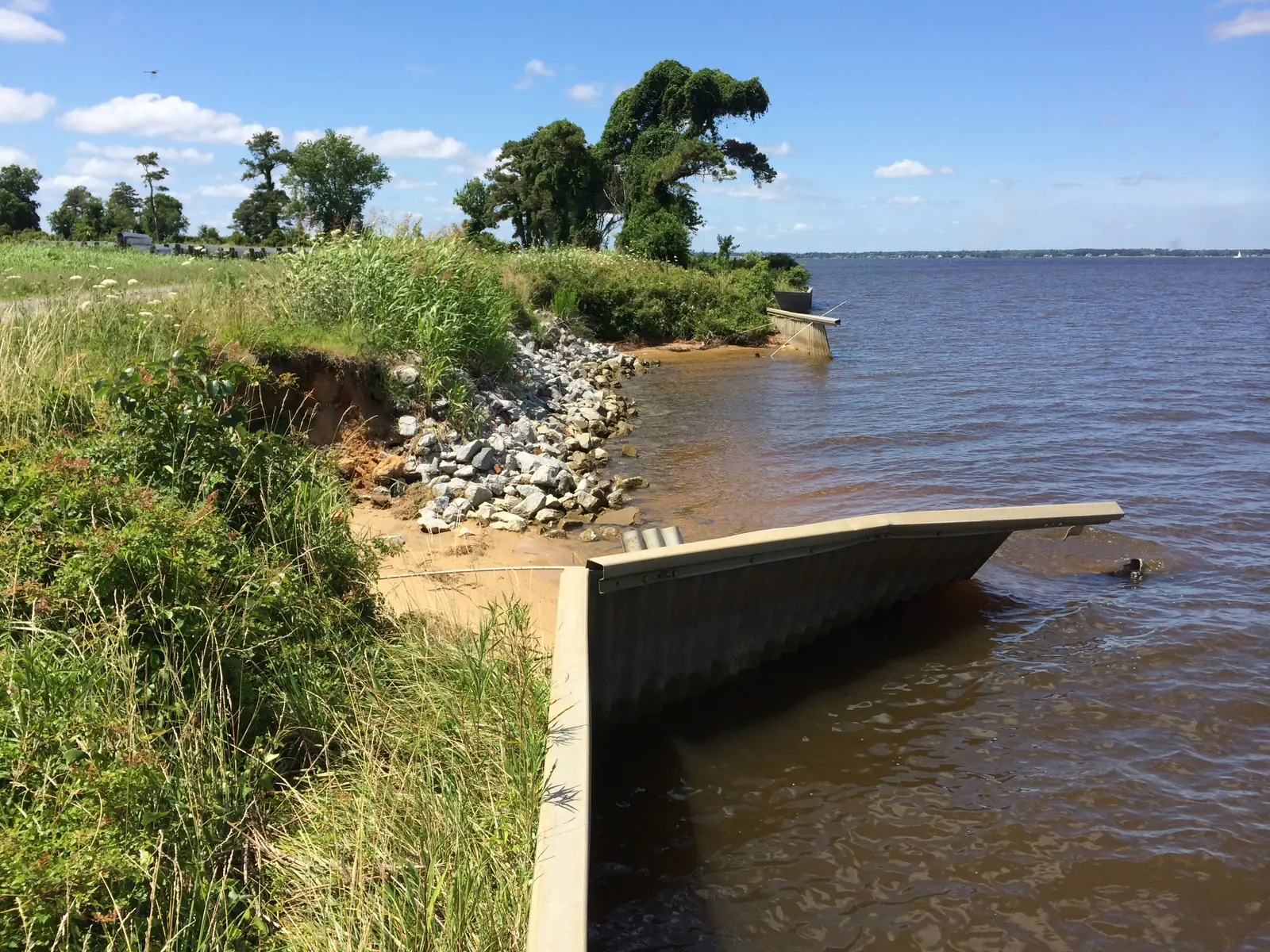
A bulkhead is a wall that holds soil back in calm water: a canal, a cove, a lake edge. It is a system of parts. Vertical sheeting holds the soil face. A horizontal wale and a row of tie rods hold the top of the sheeting back to buried anchors. A cap ties the heads together. Drainage stone and filter fabric behind the wall let water out and keep soil in.
Bulkhead repair goes wrong when the visible symptom is treated instead of the failed part. There are four ways a bulkhead fails, and they call for different work:
- the material decays, which on older walls means rotted timber;
- the tie rods or anchors fail and the wall leans;
- soil escapes from behind the wall;
- the bottom scours away at the toe.
Two or three of these are often present together, and three of the four cannot be seen from the top of the wall. That is why the first step is a diagnosis, not a quote. A seawall inspection with probing behind the wall and a look at the toe at low water costs $400 to $1,800 and decides where the rest of the money goes. The broader seawall repair guide covers the same failure modes on heavier, wave-exposed walls.
Rotted timber
Treated timber lasts 15 to 30 years in fresh water and as little as 10 in warm salt water. Two things attack it. Decay fungi need moisture and oxygen together, so they work at and above the waterline; wood that stays fully submerged holds too little oxygen for them. Marine borers are the opposite case: they attack below the waterline and are the principal cause of damage to timber piles and marine structures in salt water (Source: USDA Forest Service, Wood Handbook, chapter on biodeterioration of wood).
Treatment level matters when timber is replaced. The American Wood Protection Association's use category system puts wood in ground contact or fresh water in Use Category 4 and wood in salt or brackish water in Use Category 5, with heavier requirements toward warmer coasts (Source: AWPA Standard U1). Treated lumber rated only for above-ground use is not bulkhead material.
What to look for. Soft wood that a screwdriver sinks into at the waterline. Sheeting boards with gaps or missing sections. Wales that have split around the bolts. Pile tops that are hollow or crumbling.
Repairs.
- Replace individual members. A rotted wale, cap board or a few sheeting boards can be swapped when the piles and the rest of the sheeting are sound.
- Replace a run of sheeting. Cutting out and replacing sections of wall runs $150 to $400 per foot. That approaches new-wall pricing on a wall that keeps the age of the old one.
- Rebuild the cap. Cap repair or replacement runs $80 to $200 per foot.
When to replace. Rot does not stay local. If decay shows along most of the wall, or the piles themselves are soft, patching buys little time. The usual answer is a new vinyl seawall or bulkhead driven in front of the old timber, which stays in place as backing. If the old wall is pulled instead, treated timber is regulated waste, and removal and disposal run $30 to $110 per foot.
Failed tie rods and anchors
The sheeting holds the soil; the tie rods hold the sheeting. Steel rods corrode over the years, and anchors can pull through the soil if they were set too close to the wall in the first place.
What to look for. The top of the wall leaning toward the water while the base stays put. A gap opening between the cap and the soil behind it. Rust stains or missing nuts and plates on the wale. A wall that has bowed outward between two points that are still held.
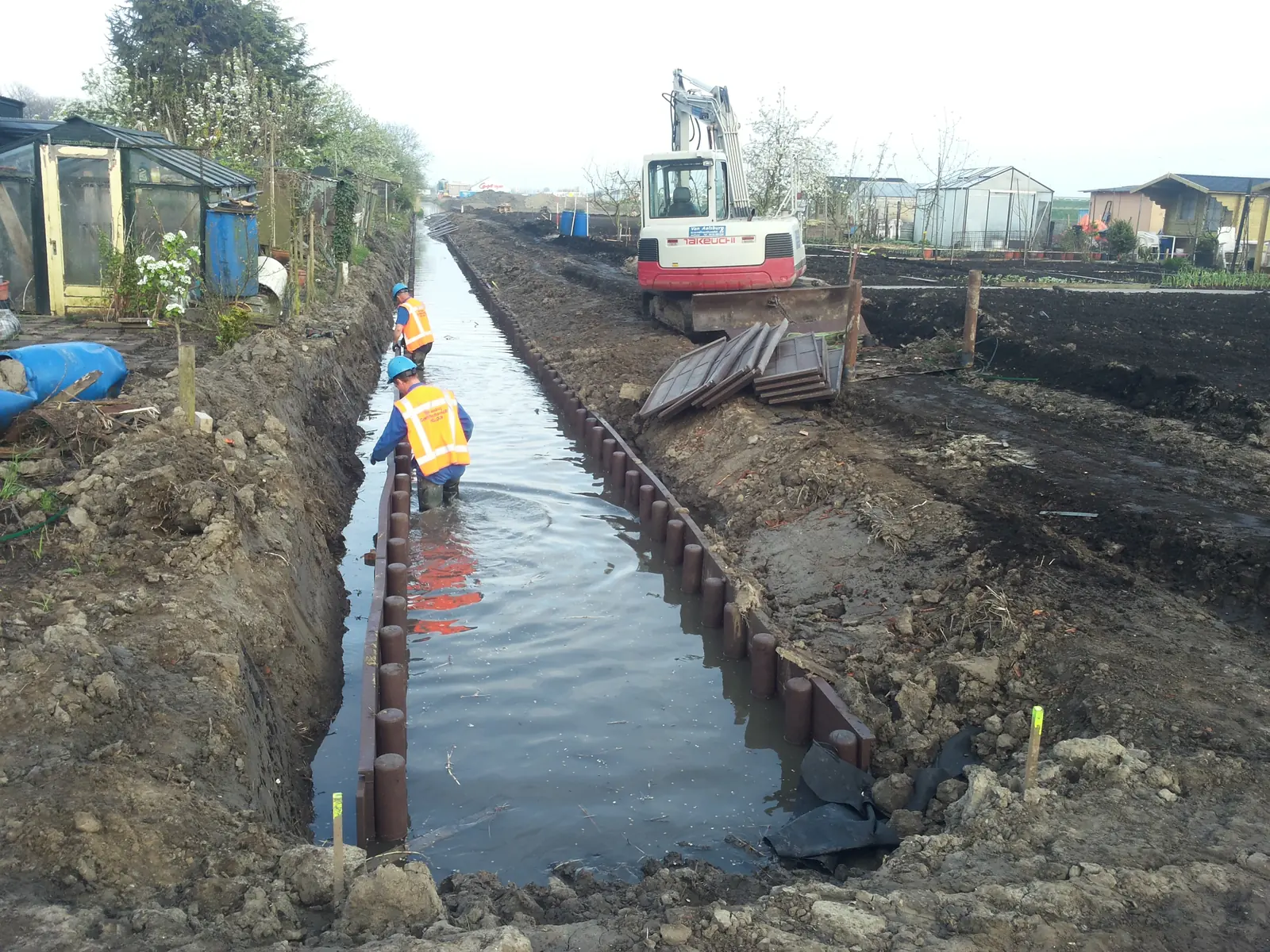
Repair. New tiebacks are installed alongside the failed ones. Anchors are drilled or trenched back into the yard at 6 to 10 foot centers and connected to a new wale across the wall face. Each anchor costs $1,000 to $3,000, and the work takes three days to two weeks on a typical residential wall.
Anchor length is the detail that decides whether the repair holds. An anchor has to reach soil that is not moving with the wall. Anchors placed inside the wedge of soil directly behind the wall show little holding value when that soil moves (Source: Caltrans Trenching and Shoring Manual). Ask how long the new rods are and where the anchors end.
This is the best-value repair in the trade. A lean with sound sheeting is an anchor problem, and new tiebacks typically total 20 to 30 percent of replacement cost while restoring most of the remaining service life. Contractors normally stabilize the wall where it stands; forcing it back to vertical cracks sheets and disturbs backfill. Expect the lean to remain visible.
When to replace. When the sheeting behind the lean is also split or rotted, new anchors are holding up a wall that will fail for another reason.
Soil loss behind the wall
Water moves in and out through a bulkhead with every rain, tide and boat wake. If the joints are open and nothing behind them filters the flow, fine soil leaves with the water. A void forms and grows behind sheeting that looks unchanged from the water side.
What to look for. A soft spot or depression in the lawn within a few feet of the wall. Pavers or a walkway settling toward the water. Irrigation lines that have sagged. Soil-colored water coming through joints after rain.
Repair, in order.
- Find the extent. A void survey by probe rod or ground-penetrating radar costs $400 to $1,800.
- Fill the void. Polyurethane foam or cement grout is injected behind the sheeting to fill the cavity and support the soil above it: $1,200 to $6,000.
- Close the path. Joints and cracks are sealed, at $25 to $70 per foot, and filter fabric is added where the wall can be opened up from behind.
- Restore drainage. Weep holes are cleared or added so water has a filtered way out. A wall with no drainage builds water pressure behind it.
- Replace lost soil and put the yard back. Backfill and restoration run $1,200 to $6,000.
Filling the void without closing the path is a repair that has to be done again. So is sealing every joint tight with no weeps, which trades a soil problem for a pressure problem.
The one piece an owner can do is sealing small joint gaps above the waterline with a marine-grade polyurethane sealant; materials run $100 to $400. It also helps to keep roof and yard runoff from discharging at the back of the wall. Yard drainage solutions covers ways to carry that water elsewhere, and foundation water deals with the same groundwater on the house side of a waterfront lot.
When to replace. When voids keep returning after filling, or when the wall has no filter fabric anywhere and the sheeting joints are open along its whole length, the soil loss is a design fault and not a defect to patch.
Toe scour
A bulkhead stays upright because the soil in front of its buried part pushes back. Current, boat wake and reflected waves remove that soil a little at a time. As the bottom drops, the exposed height grows and the embedment shrinks, and both changes work against the wall.
What to look for. At low water, more of the sheeting exposed at the base than before. Deeper water against the wall than a few years ago. The base of the wall moving outward while the top is held by its anchors.
Repair. Rock is placed along the base to stop the bottom eroding and to add weight in front of the wall. Toe protection runs $80 to $250 per foot, or about $2,000 to $9,000 as a line on a bulkhead project. The stone has to be sized for the site and laid over a filter, the same as any revetment; riprap explains the classes and layers, the rip rap calculator estimates tonnage, and riprap cost prices the stone.
Toe scour is the failure that repeats. Repairs higher on the wall that ignore an undermined base fail again in the same place.
When to replace. A toe that is undermined across several sections is usually replacement territory even when each separate repair looks affordable, because the work is patching a wall whose foundation is going.
Problem, repair and when to replace
| Problem | Repair | Typical cost | Replace instead when |
|---|---|---|---|
| Rotted timber members | Replace wales, cap or sections of sheeting | $150–$400 per ft for sheeting; $80–$200 per ft for cap | Decay runs along most of the wall or into the piles |
| Failed tie rods; wall leaning | New tiebacks and wale at 6 to 10 ft centers | $1,000–$3,000 per anchor | The sheeting is also split, rotted or displaced |
| Soil loss; sinkholes behind wall | Void survey, void filling, joint sealing, drainage restored | $1,200–$6,000 for void filling; $25–$70 per ft for sealing | Voids return, or the wall has no filter fabric along its length |
| Toe scour | Riprap placed at the base over a filter | $80–$250 per ft | The base has moved, or scour affects several sections |
| Collapsed or undermined section | Partial rebuild of the run | $25,000 and up | Nearly always worth pricing full replacement alongside |
Bulkhead repair cost
Bulkhead repair cost follows the same three tiers as seawall repair. Because a bulkhead is a lighter structure in calmer water, structural work usually lands nearer the low end of its band.
- Cosmetic and preventive, $3,000 to $9,000. Joint sealing, minor cap work, small void fills. A sound wall being maintained.
- Structural repair, $9,000 to $25,000. New tiebacks, substantial void filling, cap replacement, toe riprap. A leaning or soil-losing wall whose sheeting is still good.
- Partial rebuild, $25,000 and up. Replacing sheeting over a run or rebuilding a collapsed section.
Per foot, most repair work prices at $100 to $250, and full structural repair runs $400 to $600. Permits and sealed engineering for structural repairs add $600 to $4,500.
Access changes these numbers more than anything on the wall does. Bringing a barge in for a small repair can cost more than the repair, so bundling everything the wall needs into one visit matters. The seawall repair cost calculator prices by damage type, material and access.
Bulkhead replacement: the crossover
The practical crossover is around half of replacement cost. Below it, repair. Above it, the money buys a wall that keeps the age and the failure history of the old one.
The number to compare against: bulkhead replacement runs $150 to $650 per linear foot installed, and most residential projects fall between $12,000 and $50,000. A 100-foot vinyl bulkhead replacement on a canal or protected lakefront, with the old structure removed, tiebacks and permitting included, runs roughly $19,000 to $63,000. Replacement costs about 10 to 25 percent more than new construction, depending on whether the old wall is removed or left as backing. Bulkhead cost has the calculator and the breakdown by material.
Two cases sit outside the half-cost rule. A wall with sound sheeting and failed anchors is worth repairing almost regardless of price, because tiebacks buy back most of the service life. A timber wall near the end of its material life is worth replacing even when the current repair is cheap, because the next one is already on its way.
Replacement also raises a question repair does not: where the new wall goes. Driving new sheet in front of the old bulkhead is common and cheaper, but it moves the structure waterward, typically by 12 to 18 inches, and some jurisdictions treat that as new encroachment. The seawall construction guide covers the sequence, and the seawall cost guide covers the heavier wall needed if the site turns out to have real wave exposure.
Ask any contractor quoting the upper end of repair to price replacement beside it.
Pricing a real project? Start with the seawall cost calculator, then request quotes from marine contractors and compare the bids line by line.
Permits for bulkhead repair
Sealing joints and replacing a cap board above the waterline usually needs no permit. Structural repair, anything below the waterline and anything that places material in the water usually does.
At the federal level, Nationwide Permit 3, Maintenance, authorizes the repair, rehabilitation or replacement of a previously authorized, currently serviceable structure, provided it is not put to a different use. The permit defines currently serviceable as usable as is or with some maintenance, but not so degraded as to essentially require reconstruction. It allows minor deviations in configuration that come from changes in materials, construction techniques or current codes, which is what lets a timber bulkhead be repaired with modern materials. It also covers structures damaged by storms or floods when repair starts, or is under contract to start, within two years of the damage (Source: Nationwide Permits final rule, Federal Register, January 8, 2026). New toe rock is bank stabilization, which is generally reviewed under Nationwide Permit 13 instead.
Three practical points follow.
- Do not wait for collapse. A wall that has degraded past serviceable no longer fits the maintenance permit and needs a different authorization.
- Stay in the footprint. Repair that changes the wall's position or dimensions is treated much more like new construction.
- Check the original permit. Repairs to a structure that was never permitted can trigger a review of the whole wall.
State and local permits apply separately, and they vary widely. Who files, and what licenses and insurance to verify before work starts, is covered in the guide to hiring a seawall contractor. For how the two structure types differ in the first place, see the seawalls, bulkheads and riprap hub.
Common questions
How much does bulkhead repair cost?
Most bulkhead repair costs $100 to $250 per linear foot, with structural rebuilds reaching $400 to $600. By project, cosmetic and preventive work runs $3,000 to $9,000, structural repair such as new tiebacks and void filling runs $9,000 to $25,000, and partial rebuilds start at $25,000. A bulkhead is a lighter structure than a seawall, so structural repairs usually land toward the low end of their band.
Can a leaning bulkhead be repaired?
Usually, if the sheeting is sound. A bulkhead that leans outward at the top with intact sheets almost always has failed tie rods or anchors. New tiebacks cost $1,000 to $3,000 each, typically 20 to 30 percent of replacement cost in total, and restore most of the remaining service life. Contractors stabilize the wall where it stands; the lean usually stays visible.
How do I know if my bulkhead needs to be replaced?
Compare the repair quote with a replacement quote. Around half of replacement cost is the practical crossover. Replacement is also the better choice when timber is rotted along most of the wall, when the toe is undermined across several sections, or when the sheets themselves are split or displaced. A wall with sound sheets and failed anchors is the opposite case and is worth repairing.
Do I need a permit to repair a bulkhead?
It depends on scope. Sealing joints above the waterline usually needs nothing. Structural repair, work below the waterline and anything that places material in the water usually needs authorization. Repair or replacement of a previously authorized, still serviceable bulkhead in the same footprint is the easiest path, and federal Nationwide Permit 3 exists for that kind of maintenance. Check state and local rules as well.
How long does a bulkhead last?
Marine-grade vinyl lasts 40 to 50 years or more, composite 30 to 50, steel 25 to 40 in fresh water and less in salt, and treated timber 15 to 30 in fresh water and as little as 10 in warm salt water where marine borers are active. Tiebacks and backfill usually govern the real service life, not the sheet material.